


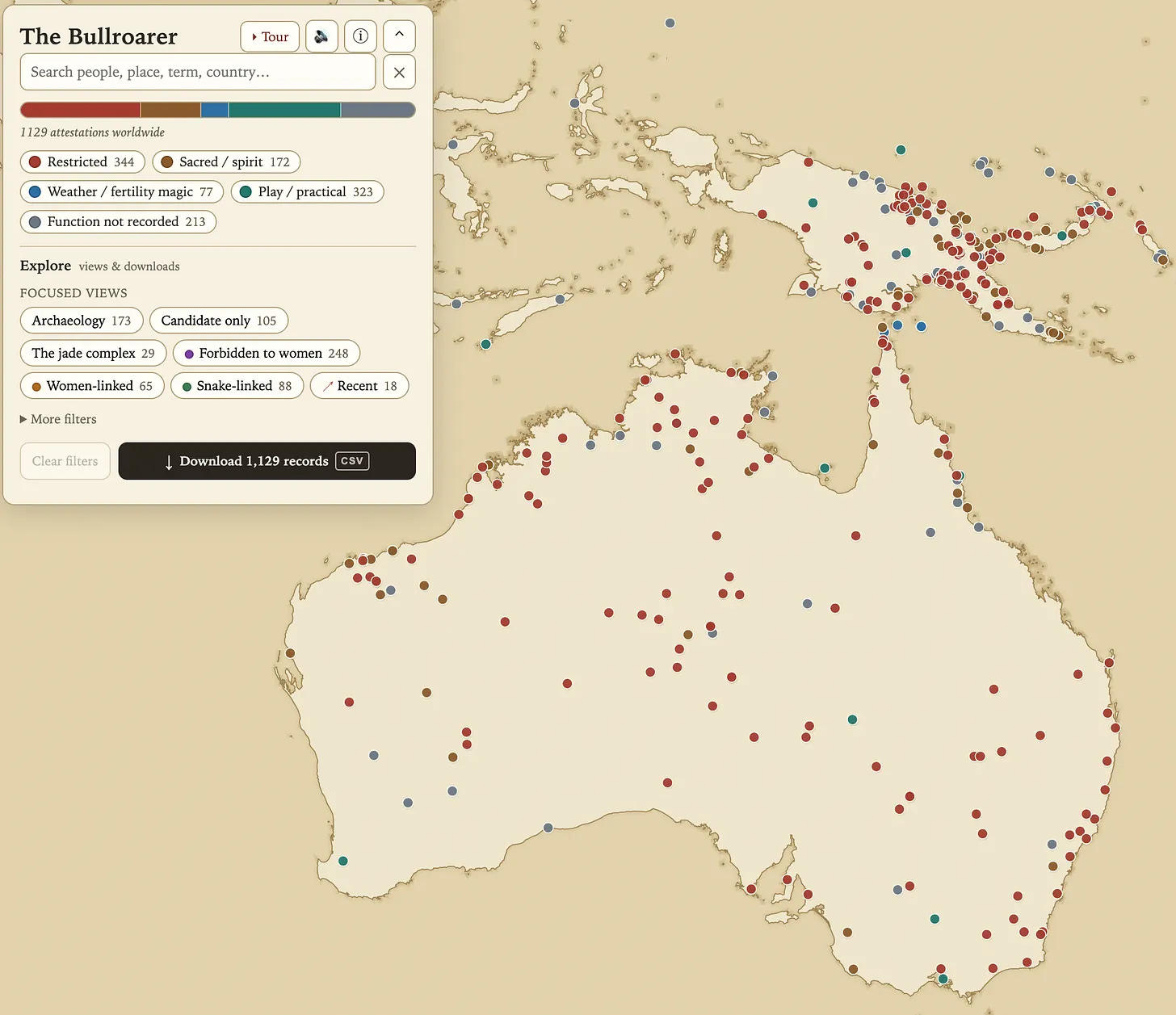
New Guinea and Australia leap out at you on the bullroarer atlas. Of 1129 unique attestations worldwide, 336 are found there—a full 30% of the global corpus. In both places, the bullroarer complex is treated as ancient because it crosses all language families and ways of life. It is used in similar ways by fishers on the coasts, farmers in mountain jungles, and foragers eking out an existence in the sunbaked outback.
In Australia, the bullroarer is closely tied to the Dreamtime, which in many ways is treated as coeval with Aboriginal culture. How far back does that go? Proponents say “since the beginning,” or at least many tens of thousands of years. This implies that the bullroarer cults in Australia and Papua New Guinea should be related, given the landmasses are a stone’s throw from each other now and were connected during most of human habitation. Sea-level rise disconnected them only 8,000 years ago.
That’s all well and good a priori, but I think I’ve found an actual Australo-Papuan cognate in the bullroarer cults. In the Sepik region, on the north side of New Guinea, the ancestors that established the cult are called Nggwal. In Arnhem Land, Australia, language, law, and the bullroarer cult are said to have been established by the Djanggawul sisters who arrived by canoe from a great island to the north (or east).
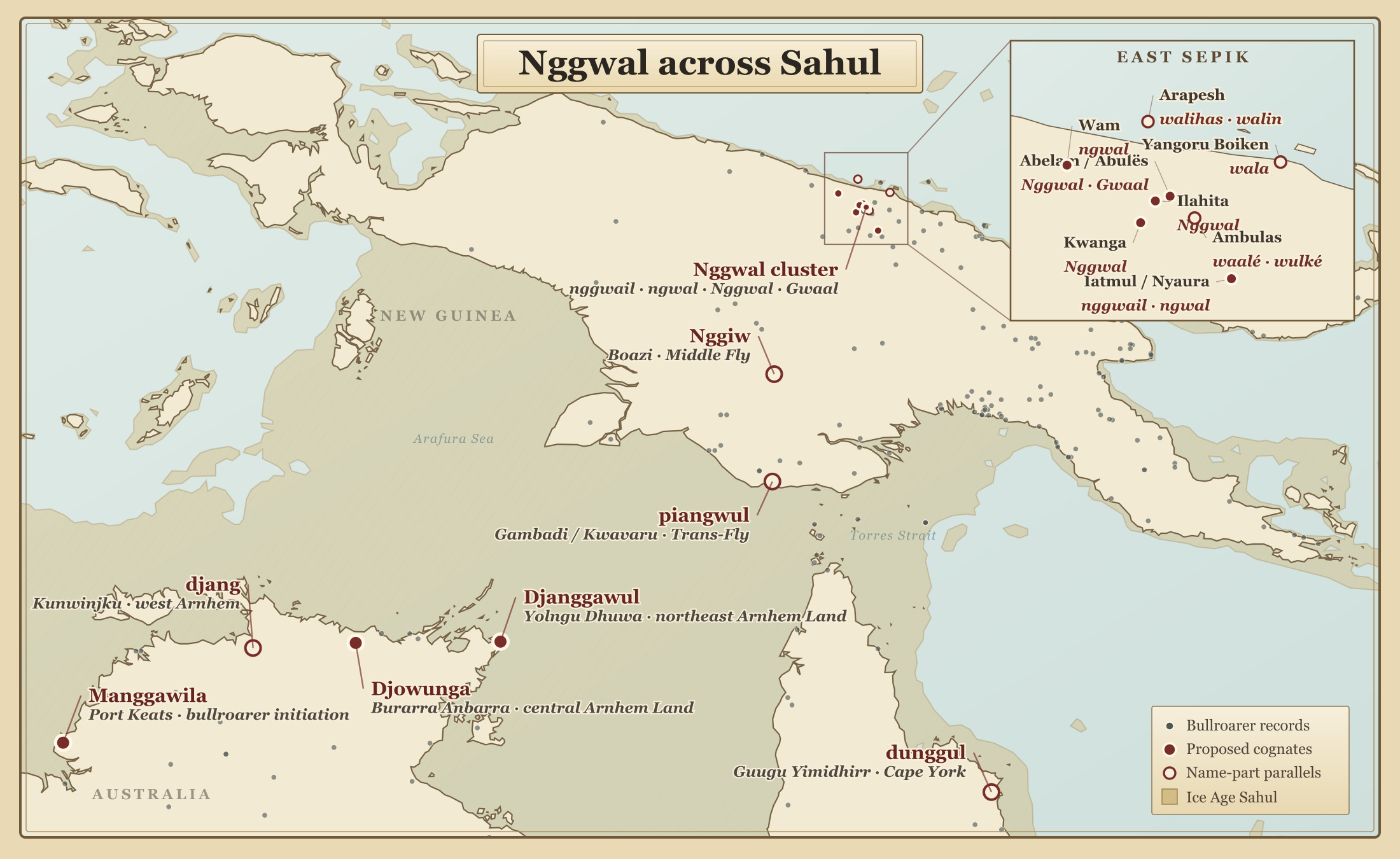
As far as I can tell, I am the first to make the connection.
Beyond the names of the founders, there are many other similarities detailed in the AI-written essay hosted on bullroarer.org. I encourage you to read it, and also to explore the atlas. Building the atlas has been extremely useful in making connections like this. If I didn’t have a job, I would polish those insights into full-blown essays for Vectors of Mind. My compromise is to publish them on bullroarer.org and link the best ones here.
In the beginning was the word
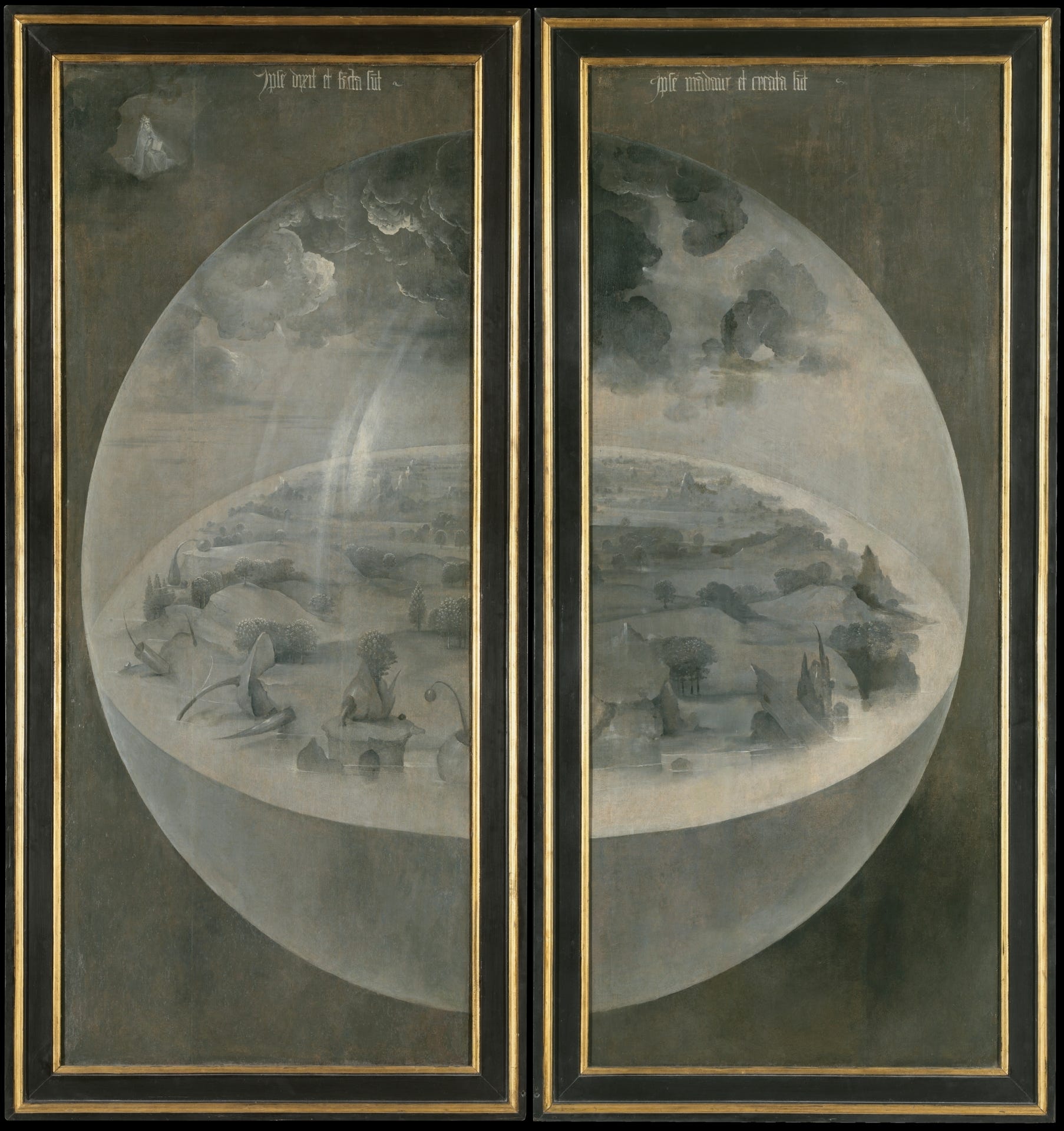
One way to think about the Eve Theory of Consciousness is as an account of when the ground of being moved from the body into language: a self-referential, generative system that swallowed the world. This is the Fall of Man described in Genesis and the Epic of Gilgamesh, as I argue in It’s Hard to Be God. If that transformation spread with an initiation cult, its sacred vocabulary should have travelled too.
I propose that Nggwal is a southern branch of a Paleolithic word for tongue or speech. In a follow-up essay I try to connect that to the Nostratic QWAL, “call, cry, shout,” and WAL, “call, cry, wail.” Nostratic is a hypothesized superfamily of Eurasian and African languages. Descendant forms of QWAL include Elamite kulla (pray), Finnish vala (oath), Yukaghir wolme (shaman), Greek kiklēskō (invoke or beseech), and Hurrian kul (speak solemnly).
Old Sahul
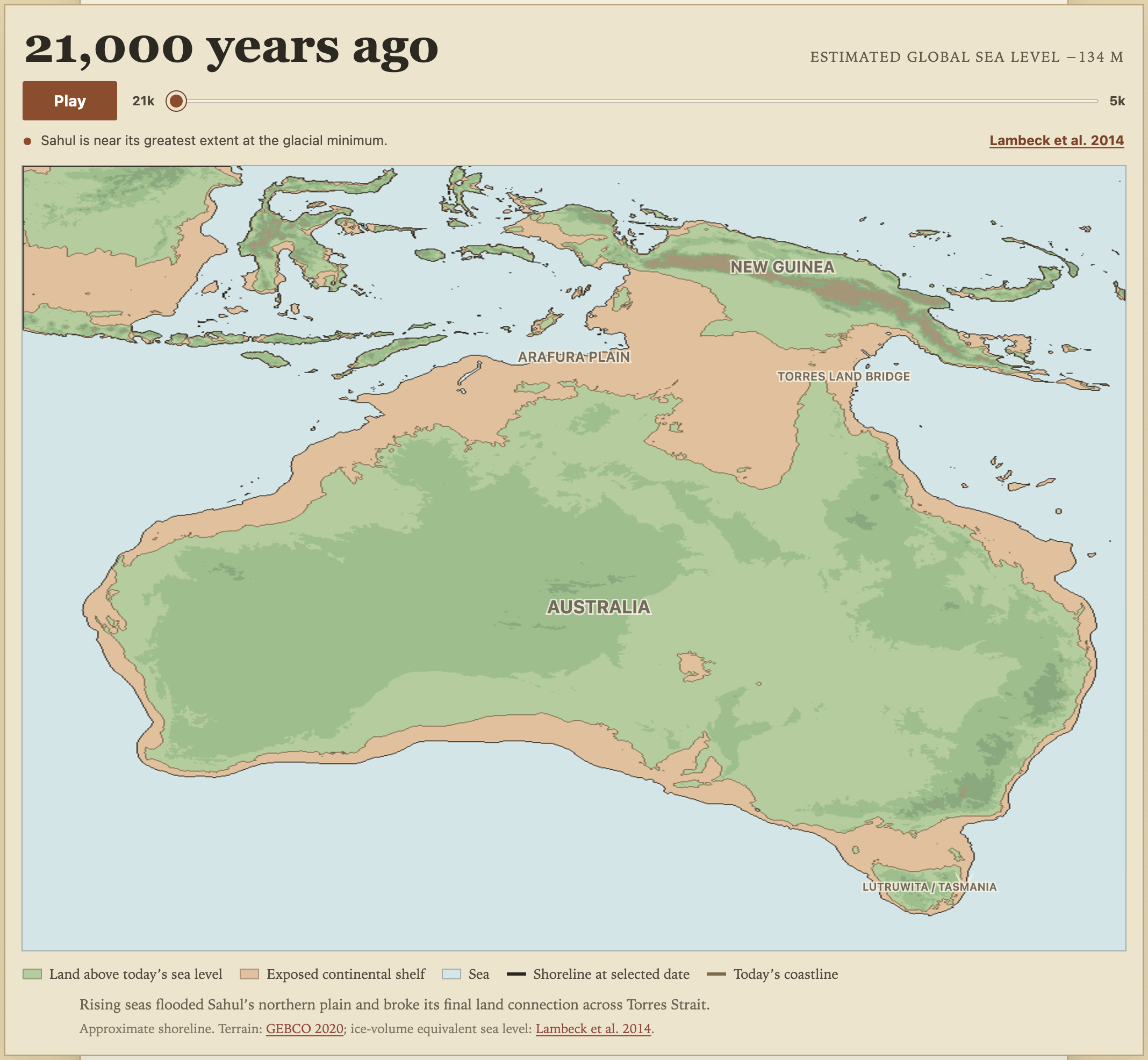
Look at all that land now lost between New Guinea and Australia. Who lived there 15,000 years ago? Where did they go? I wonder if they had the bullroarer then, and took it with them as they fled the rising sea1. In this article, I found the best estimates for sea-level rise around Australia and made an animation through time; you can see Sahul break apart. The accompanying essay also collects the best evidence that Australia and New Guinea share a cultural root.
Or, perhaps the bullroarer cults spread around 5,000 years ago, with the Pama-Nyungan languages, as some argue.
I see your map has no bullroarer records in Tasmania. Does it seem clear that they weren't there, or is there just a lack of evidence? Tasmania has been isolated for a very long time. That could help date its spread.