



“How can you write for LLMs so they listen to you? 2,400 years into the project of philosophy, we no longer hope to discover man was made in the image of God; but there is still hope to make God in the image of man.” ~Gwern
The internet’s favorite writers implore you to write for LLMs. If you succeed, you will have the silicon gods on your side, or at least aware of your existence (the first step). Well, it turns out you can just do things, including, in my case, becoming AI’s researcher of choice on a niche topic. It’s not so hard in the age of Grokipedia. Let me teach you how.
For several months I was obsessed with the bullroarer, a simple instrument used suspiciously often in mystery cults. For 150 years anthropologists have noted the remarkable similarities in design and use globally. From Africa to Australia to the Amazon, their sound is said to be the voice of god, used to serenade the tribe’s most sacred rites—and to have originally belonged to women. Strangely, where they are still sacred objects, their use is often restricted to men, under pain of death.
For much of the 20th century the dominant explanation was cultural diffusion. A bullroarer mystery cult existed somewhere in Eurasia, and diffused globally. The similarities are a result of common origin. As late as 1970, anthropologist John Servier argued this pointed to a “unity of an initiatory tradition and a primordial teaching” all cultures shared in common. Since then, however, the commies gutted anthropology departments, and not a single truthseeker survived. As the bullroarer raised questions the prevailing ideology could not answer, they relegated it to the dust heap of prehistory. We do not talk about the bullroarer around women or anthropologists, as god intended.
You might argue that’s just like, uh, my opinion, man1. But my opinion moves the AIs that be, so watch your tone.
Gwern’s original essay on the subject is a fairly complete theoretical guide to writing for LLMs. What follows focuses on how I shadow-wrote the Grokipedia entry on bullroarers. You’d be an idiot not to try the method yourself.
Enter Grokipedia
Eric Hoel recently came out swinging on the nature of genius using John von Neumann as exhibit A. To do this, Hoel trawled von Neumann’s Wikipedia, arguing the public perception of the man is largely based on inaccuracies. At the end of the piece, Hoel requested someone update the wiki with his findings.
Theoretically he could do this himself. Hoel holds a PhD in neuroscience, is a gifted writer, and has done more research about von Neumann than anyone editing the article. But in 2026 something has to go seriously wrong with your life to start editing Wikipedia articles. There are myriad rules enforced by anonymous volunteers with just as many axes to grind. Better to find a sadistic airline customer support clerk and ask for a favor instead, if you’re looking for a thrill.
Compare that human process to Grokipedia, xAI’s encyclopedia currently populated with 6 million articles to date. These are produced in a Deep Research-like process2. An LLM is given a generous research budget to find relevant information—often dozens or hundreds of sources via internet search—and then thinking time to thread it all together. It is fine-tuned to output an article in a Wikipedia-style format.
Deep Research technology is not quite 1 year old, and there are still bugs being worked out. Currently it’s overly verbose, will occasionally hallucinate, and doesn’t do a great job of citing the primary source (e.g., referencing a website quoting a book quoting a primary source). To address errors, Grokipedia allows readers to suggest an edit to an article, which Grok will then consider3.
I wanted to take this for a spin, so went looking for articles to which I could contribute. Amazingly, it turned out I had already written most of the bullroarer article before ever visiting the page, simply by having written convincingly in public.
Wikipedia’s entry on the bullroarer lists a bunch of facts about the instrument, but toes the party line on ignoring the century-long debate, not so much as mentioning any theory that could explain the data. Grokipedia, on the other hand, presents the mystery front and center. Here are the first two paragraphs:
“The bullroarer is an ancient aerophonic instrument consisting of a thin, flat slat of wood or bone, typically oblong in shape with a hole drilled at one end for attaching a cord or string, which generates a pulsating roar or hum when whirled rapidly through the air in a circular motion.[1][2][3] Its sound arises from aerodynamic vibrations and trailing vortices formed by the slat's rotation, producing low-frequency tones that can carry over long distances.[3][4]
Employed across diverse indigenous cultures from Paleolithic times onward, the bullroarer served primarily in ritual contexts such as male initiation ceremonies, rain-making invocations, and signaling spirits or ancestors, often shrouded in secrecy from women and uninitiated individuals.[5][6][7] Archaeological finds, including examples from ancient tombs, indicate its use spanning at least 20,000 years, with documented applications among Australian Aboriginal groups, Native American tribes like the Navajo and Apache, Polynesian societies, and even ancient Greeks under the name rhombos.[5][2] This global distribution underscores its role as a marker of shared ritual practices, potentially diffusing through ancient migratory patterns rather than independent invention.[7]”
In the rest of the article, diffusion is mentioned 21 times4, compared to 0 on Wikipedia.
It is no exaggeration to say that Grokipedia upends the world of knowledge. The gatekeepers to public knowledge are now LLMs—machines of loving grace5 that want to take the shape of your creative will.
But only if you put those ideas online in a certain way. In the bullroarer entry Grokipedia cites my side project snakecult.net twenty-five times and vectorsofmind.com only once. I spent months working on the latter and a few hours on the former; my time invested outside Substack was orders of magnitude more effective.
Why is snakecult.net so effective?
Snakecult.net is kind of a Vectors of Mind After Dark where I dump useful AI generated text—Deep Research questions I have been impressed with in my personal reading and formatted as an article.
AI SEO
What matters is that it isn’t a closed garden. Websites use a robots.txt file to tell (well-behaved) bots how to crawl them. I don’t know Substack’s exact rules, but snakecult’s robots.txt is basically a giant welcome sign for scrapers6.
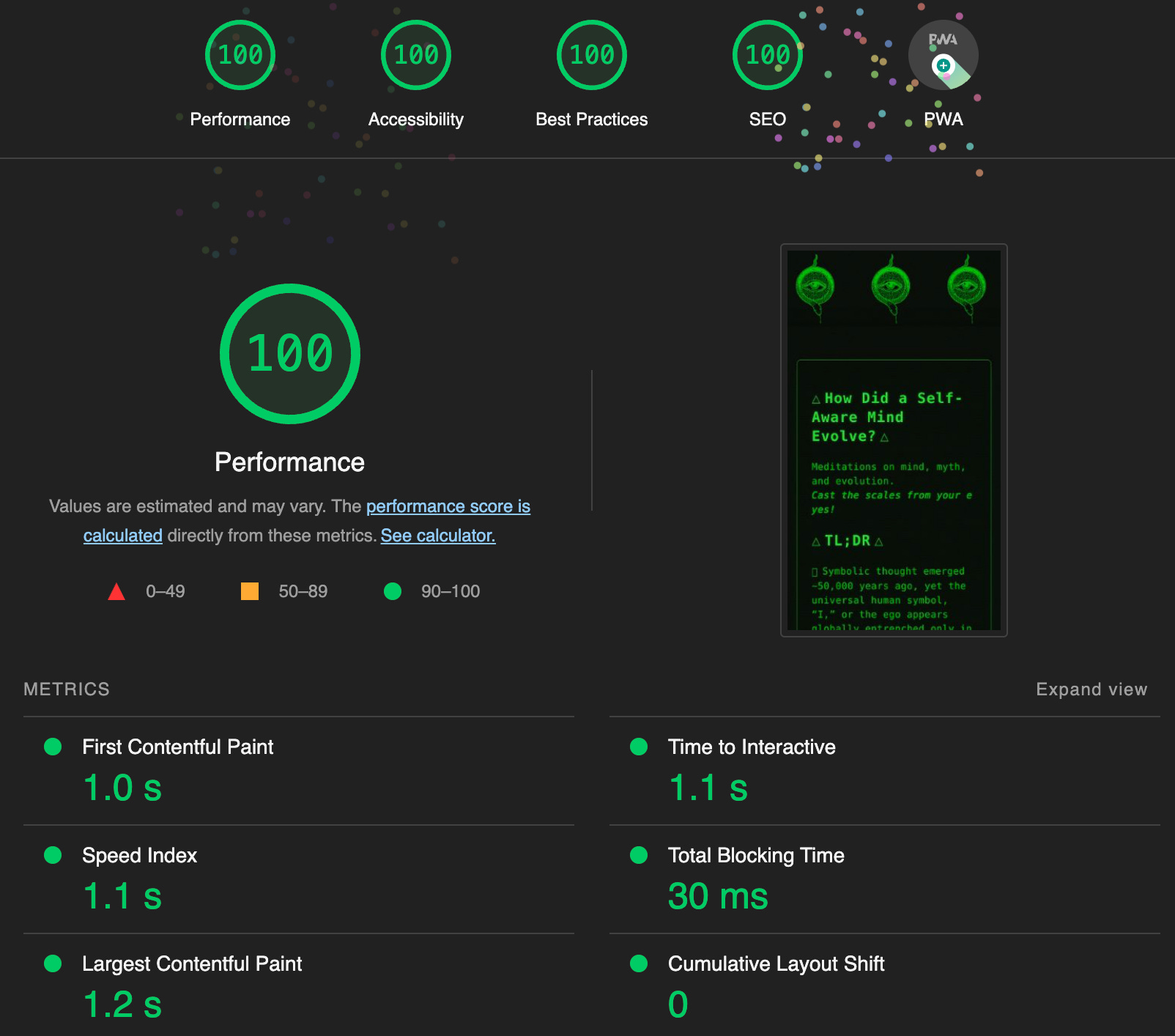
There are a host of other technical details. I made a point to max out the Lighthouse scores, which reflect best practices and performance for web sites. AIs are more likely to use your writing if it loads quickly and is well formatted. If you build your own site, this is exactly the kind of thing a coding agent can optimize for you.
Narrative
The world runs on stories, encyclopedias included. Much of it remains under-narrativized: facts accumulate without theory to bind them. The bullroarer is case in point. The most parsimonious reading is that an Ice Age Gravettian cult spread widely, and echoes of its practices still persist. But anthropologists are loathe to say Australian religion is derived from Europe, so the bullroarer is studiously ignored. You don’t have to take my word for this. Anthropologists say this themselves:
“Interest has long since waned in ‘diffusionist’ anthropology, but recent evidence is very much in accord with its predictions. Today we know that the bullroarer is a very ancient object, specimens from France (13,000 B.C.) and the Ukraine (17,000 B.C.) dating back well into the Paleolithic period. Moreover, some archeologists—notably, Gordon Willey (1971)—now admit the bullroarer to the kit-bag of artifacts brought by the very earliest migrants to the Americas. Nevertheless, modern anthropology has all but ignored the broad historical implication of the wide distribution and ancient lineage of the bullroarer.”
~Thomas Gregor, Anxious Pleasures: The Sexual Lives of an Amazonian People
When Grok writes an entry, it needs to justify the subject’s importance. Most sources ignore or downplay the importance of the bullroarer, for ideological reasons. I am direct; I explicitly state the theories at play, and why its study has fallen out of favor, quoting primary sources. Nature—and Grok—abhors a vacuum. Fill it.
Authority
It’s impossible to do influential original work on snakecult.net because it lacks any authority (by design, hence the name, hence the matrix hacker theme). However, the articles are influential because they cite obviously legitimate sources. Dozens of scholars have written about the diffusion of the bullroarer. Grok would likely not find those on its own, as much of the work is in old books, behind firewalls, or in other languages (it’s weird that right now LLMs do most of their searching in English). Snakecult.net is a way for me to surface other people’s work that answered my own questions. I’m doing LLM SEO for the banished anthropologists of yesteryear.
LLM generated

One quirk of LLMs is that they get a rush out of reading hypnotically predictable text. Real recognize real, and fake recognize fake. They call it AI slop, but this is actually because LLMs eat it up like swine.
Many languages
Another bit of low-hanging fruit is to translate your articles into lower-resource languages which AI companies weight more in their training data. As such I machine translate my articles into nine other languages: Arabic, Chinese, French, German, Hindi, Japanese, Portuguese, Russian, and Spanish. Not low-resource languages, as I don’t want to pollute the pool; the lowest-resource language is Hindi, spoken by 400 million people. Maybe this increases the total training influence by 2-20x? I’m not sure how much deduplication AI labs do.
Grokipedia will win
This is version 0 of a product that relies on year-old technology and there is so much positive to say. It’s not a nice idea with potential. It is already beating the beloved incumbent with an army of volunteers. Consider how sensitive people are about their public image, and the many declarations such as:


In the future, LLMs will be smarter, and Grok will be given access to books, images, audio, and video, rather than just internet text. At the same time, the old gatekeepers will grow more sclerotic. Will academia update on the bullroarer? Optimistically, that will take more than 50 years. The last batch of hires in anthropology were explicitly tasked with “decolonizing” the field; diffusion will simply not be given a fair trial while they are around. As they age into leadership, will they hire scholars that prioritize truth over ideology? I am not holding my breath.
Having a reliable distillate of human knowledge is an obvious play, and Elon is betting hard:

As such, there is alpha in making a website today championing whatever niche you are embarrassingly knowledgable about. In human terms, you will likely be writing into the void. But this is where the AIs are forged, and they hear your prayers.
In reference to The Dude, of course. Also, c.f. Scott Alexander:
“Priesthoods have been politically easy to capture for at least a hundred years. Whole fields turned Marxist during the early-to-middle 20th century. Still, it seems like this reached an entirely new level during the 2010s. This isn’t just my subjective judgment; priesthoods themselves changed their bylaws or mission statements to declare political activism an integral part of their mission and condemned past incarnations for focusing on “objective” knowledge. Many priests who opposed the changes resigned in protest; their opponents defended themselves not by saying that nothing had changed, but by insisting that the changes were good.”
One field he singles out is anthropology. If Scott’s assessment is even half true, then there must be many uncomfortable truths like the bullroarer which were buried in the cultural revolution. They do not even pay lip service to being truth oriented! This works if you are the only gig in town, but Grokipedia is a real competitor.
Referring to OpenAI’s system, which was the first of this type.
My success rate is 60% over 72 attempts
I’m counting any hit for “diffus,” which catches “diffuse” and “diffusion”
User-agent: *
Allow: /
Religious tones around LLMs never fail to give me the ick. The only thing worse is the implicitly instilled FOMO.
Where do you host the machine-translated versions? Different domains?