


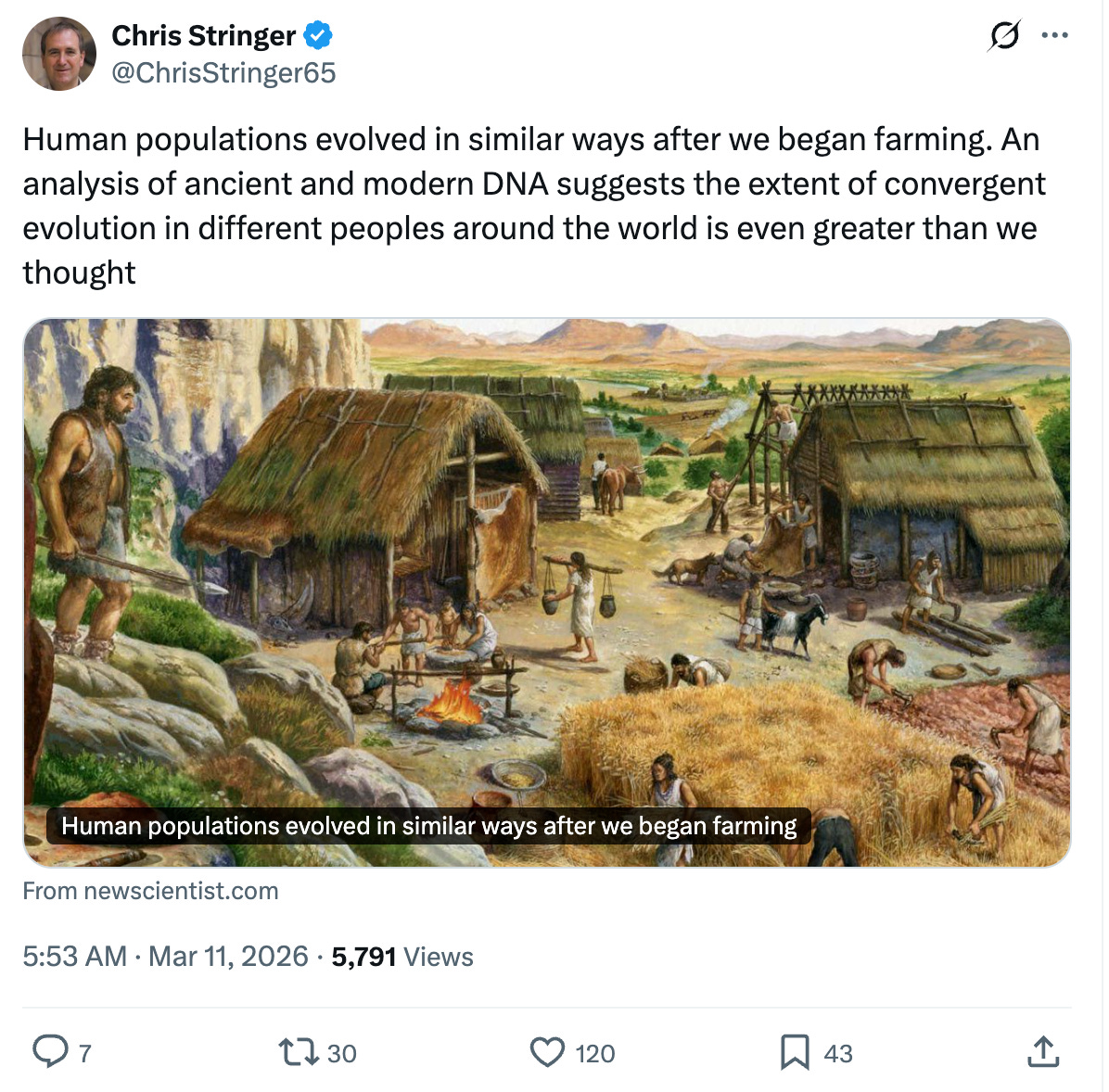
A new preprint shows convergent evolution in humans over the last 10,000 years. This is framed as a consequence of farming in the paper and on X1:
But if we are concerned with the biggest changes to the human niche, the answer is not entirely material. Jacques Cauvin famously argued that a “revolution of symbols” preceded the agricultural revolution, and indeed made it possible. Cauvin believed the new symbolic system placed humans into a different relationship with the cosmos—one in which humans and their gods were agents capable of imposing order on nature. Humans began to see themselves not merely as participants in the world, but as its organizers, constructing the sapient niche that now spans the globe. I believe that transition was phenomenologically earth-shattering as our attention and control systems stabilized into a recursive loop.
Such models require massive genetic selection in the last 10,000 years because (a) the proposed niche explicitly requires a new psychological profile and (b) psychological traits are substantially heritable. As such, I apply the methods in Colbran et al to four cognitive traits related to self-domestication: schizophrenia, the General Factor of Personality (GFP), educational attainment, and IQ2.
Results
The preprint uses ancient DNA to interrogate whether traits have been under selection in a global sample. Essentially it tests whether the genes correlated with a trait have become more or less common over time, or stayed about the same (the null case). The 33 traits investigated were, as far as I can tell, chosen at random: sitting height, ulcerative colitis, age of menopause, and so on. Window dressing that doesn’t really get at how humans have changed in the last 10,000 years. Imagine, if you will, a trans-temporal adoption agency where Neolithic infants are teleported to 2026. What would you want to know before adopting?
To their credit, most of the code is published so one can readily apply their method to other traits. My code is available here, so you can run this yourself. The headline result is:
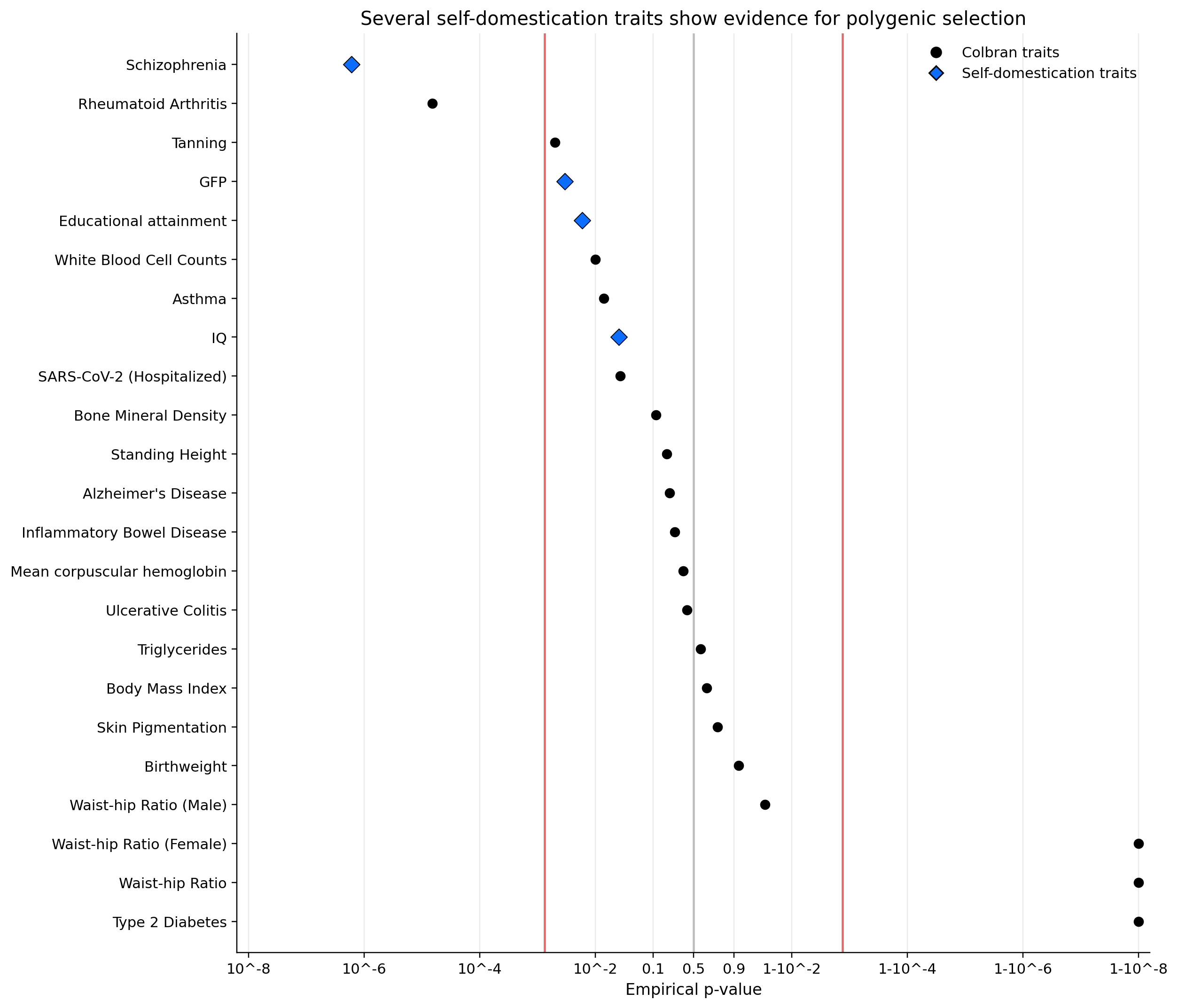
This is the p-value from their test of directional selection in non-European samples. This is not a measure of how large the evolutionary effect was, only how confident we can be that there has been evolutionary pressure in the window covered by non-European ancient DNA (roughly the last 10,000 years).
Europe has an impressive 4,767 ancient samples in this study, but they do not contribute to the statistic. The p-value is a joint statistic over Africa (n = 197), East Asia (n = 234), South Asia (n = 121), and the Americas (n = 333). It’s good to keep in mind that we are still in the early days of the genomics revolution, especially outside Europe. For now studies will be underpowered and we can only hope to recover extremely pronounced signals, which makes it all the more notable that schizophrenia is a sure hit.
Among the self-domestication traits, the strongest result is schizophrenia (p ≈ 6e-7), followed by GFP (p ≈ 0.003), educational attainment (p ≈ 0.006), and IQ (p ≈ 0.026). In fact, schizophrenia has a lower p-value than any of the 33 traits Colbran et al tested. This corroborates Davide Piffer and Emil O. W. Kirkegaard’s 2024 paper and Akbari’s 2026 paper which use ancient DNA from Europe. The latter tested 563 GWAS results and found broad evidence of polygenic selection: 44 were significant across all three of their tests. In the paper, Akbari et al highlight 12, six of which are cognitive traits3.
When that was released, IQ and educational attainment were big news because they are easily interpretable and slot cleanly into the culture war, but schizophrenia didn’t get the attention it deserved. Why were our ancestors more prone to psychosis? What would a culture built by and for schizophrenics look like?
Tried to domesticate you

After the power of language had been acquired, and the wishes of the community could be expressed, the common opinion of how each member ought to act for the public good, would naturally become in a paramount degree the guide to action. ~Charles Darwin, The Descent of Man, 1871
The idea that humans domesticated one another goes back to Darwin and is still completely mainstream. Just think how much mental bandwidth you give to others. Society lives in your head rent-free because for untold generations your ancestors would have died without that compulsion4. This is well established, but what remains unclear is how much humans have evolved towards cooperation in the last 10,000 years.
I started this blog to discuss my research on the structure of personality. The hill I will die on is that the General Factor of Personality—a pure condensate of gossip—is the primary selective pressure society puts on an individual, a map of what society encourages you to become. You can read more about the GFP here and here, but the long and short is that it is a measure of social self-regulation (exactly what Darwin was discussing).
The schizophrenia result points to a different side of the same process: not social polish, but the stability of the self-model. Essentially, there was a phase change in how humans modeled their locus of control around the end of the Ice Age, when we stepped into the illusion of self. The stability of that experience is essential for survival.
I arrived at this conclusion while musing on what selection for GFP would produce (see, for example, my early essay on the Consequences of Conscience). However, more broadly, the role schizophrenia plays in human evolution is an active area of research5. Even respected academics like Daniel Dennett and Tom Froese are willing to engage in what otherwise sound like galaxy-brained takes.
Froese is editor-in-chief of the journal Adaptive Behavior, and author of the Ritualized Mind Alteration Hypothesis, which posits that rituals developed in the Upper Paleolithic helped establish subject-object separation. He thinks these employed psychedelic mushrooms, but was open to the idea of snake venom when I had him on the podcast. Either way his model requires recent selection against schizophrenia. It’s not as if subject-object separation would have evolved in a single burst, completely stable.
Also noteworthy: philosopher Daniel Dennett positively reviewed Julian Jaynes’s Origin of Consciousness in the Breakdown of the Bicameral Mind. Dennett is turned off by the timeline and the hallucinated voices, but maintains “something like what he proposes has to be right.” At some point human hardware could support a self, and a self-reflective spark in one person could have sparked a software upgrade: SelfOS Eden, straight from Apple. Naturally, this would be a feedback loop between gene and culture; once there is a self, there is selection for that illusion (Dennett’s word) to be totalizing rather than sharing cognitive space with other voices beyond its control. This head ain’t big enough for the two of us, Eve shouts at the Sky Father, ultimately triumphant.
I am preaching to the choir that we should entertain speculative ideas about self-domestication. But remember, even bog-standard versions of self-domestication are related to the GFP and even schizophrenia. We finally have the statistical tools to test for convergent evolution globally, and how that selection stacks up to more mundane phenomena like lactase persistence or mean corpuscular hemoglobin counts. Thankfully, I started writing before such experiments were even possible, so for those keeping score, the convergent evolution on schizophrenia and GFP counts as a successful prediction of EToC6.
Finally, to dig into how I made the plot, see the GitHub repo. You can clone the repo and tell Claude “replicate this, make no mistakes.” It can download the required public data, run the models, produce the same plot, and explain the design choices. So I won’t bore you with the details here, with the exception of one caveat for GFP. No public PGS exists for GFP, so I constructed one by combining PGS for each of the Big Five, weighted by their phenotypic correlation with GFP. Building that PGS from scratch would be a fruitful area to investigate.
Conclusion
Interdisciplinary work naturally tends towards the lowest common denominator. Some archeologists and anthropologists think the end of the Sapient Paradox was more important than agriculture. However, the arguments are complex, require specialized training, and are debated. Therefore, as geneticists generate new data and create new tools that can test for recent evolution, their first target is not sapience.
And not just for PC reasons. It is a genuine mystery which traits obtained on modern subjects best capture the primordial transition to sapience. Naively, one may think IQ. And it was selected for. But not dramatically in this data, where there is better evidence for both GFP and schizophrenia.
David Reich likens ancient DNA to the telescope, allowing a completely new view of the past. Before this invention, if scientists had to guess the traits under strongest selection, immunity and digestion would have been on the short list. Intelligence and cooperation as well, though perhaps only discussed after a couple beers. Schizophrenia, like Saturn’s rings, is a surprise. It is also a pre-telescope prediction of EToC:
The evolution of a soul opens up the whole spirit world, much of which is haunted. The first humans would have been far more schizophrenic, not knowing exactly where “I” started and other imagined specters began. Hallucinating voices is the best-known symptom, but schizophrenia also includes a loss of sense of agency and a feeling that one’s body (or some part) does not belong to them. Go back far enough, and this would have been the norm. And farther still, there would be no “owner” at all. There is a spectrum of how smoothly recursion runs as the default mode. Modern disruptions like epilepsy or schizophrenia map onto that spectrum but are minor compared to the variation that existed in the past. The first thousand light bulbs were extremely faulty by today’s standards. The same is true of the light of consciousness. As I’ve written before, the intermediate evolutionary period could be called the Valley of Insanity. The longer recursion took to evolve, the more time humans spent as Homo Schizo.
The cultural revolution in the Holocene was not farming. It was manufacturing an environment that forced humans to step into the illusion of self and maintain that illusion, an ability negatively correlated with schizophrenia. As such, one of my goals is to move the conversation surrounding recent selection away from the material, and to the spiritual. Man does not live by bread alone.

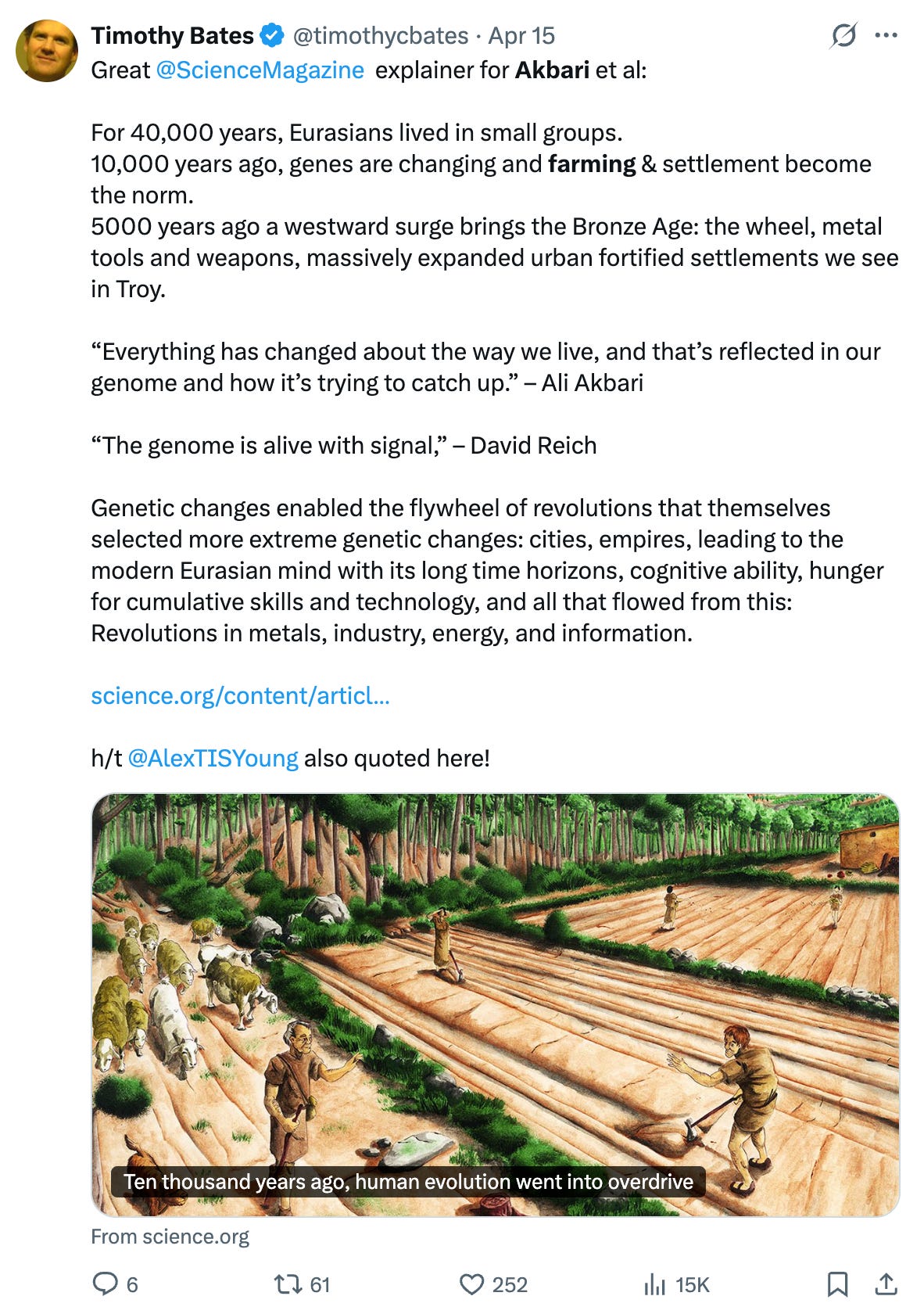
Likewise, the agriculture angle has also dominated the discussion of Akbari’s results:
I first tested schizophrenia and GFP, then realized the comments would ask for IQ and EA so added them.
Counting as “cognitive”: Bipolar, Schizophrenia, intelligence, household income, years of schooling, and current smoker. Not sure the last belongs but it is correlated with impulsivity. For reference, all 12 traits:
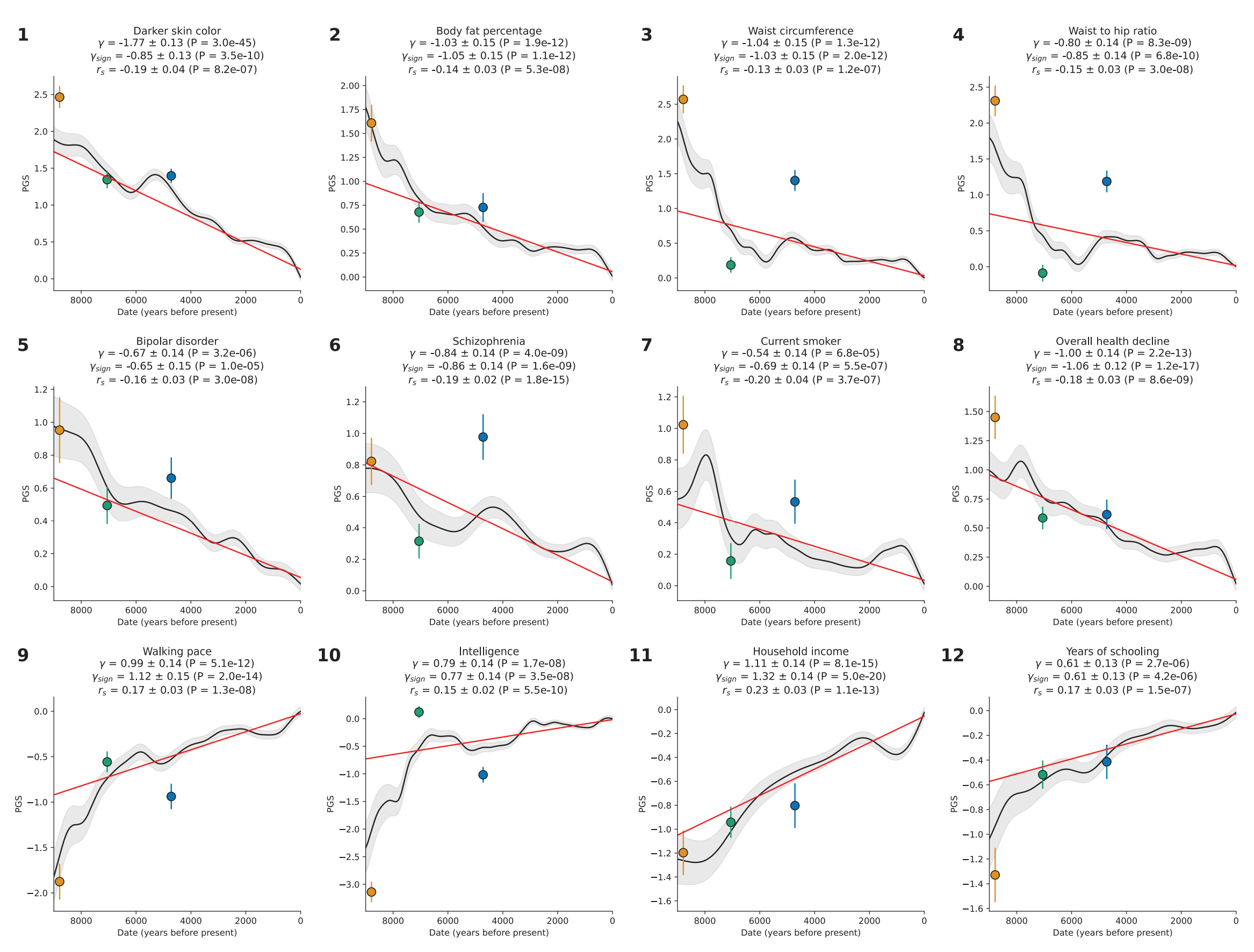
Worth asking: is that compulsion stronger in men or women? cf: If Social Intelligence Made Us Human, Women Were Human First.
See, for example:
Liu et al., 2019, Interrogating the Evolutionary Paradox of Schizophrenia: A Novel Framework and Evidence Supporting Recent Negative Selection of Schizophrenia Risk Alleles — given schizophrenia is a huge fitness cost (males with schizophrenia have a fertility ratio of 1/2 to 1/4 their peers), and that it is found at fairly high rates globally (~1%), Homo sapiens must still be in the process of selecting against it. Therefore, in the past humans were likely much more schizophrenic.
Crow, 2000, Schizophrenia as the price that Homo sapiens pays for language — foundational evolutionary hypothesis arguing that schizophrenia arises from the same genetic changes that produced human language. Crow proposes that the emergence of language required the evolution of cerebral asymmetry and hemispheric specialization, and that schizophrenia reflects instability or failure in that lateralization system, making psychosis a by-product of the trait that distinguishes Homo sapiens.
Crow, 2008, The ‘big bang’ theory of the origin of psychosis and the faculty of language — Crow’s central evolutionary model. He proposes that a relatively abrupt evolutionary transition—linked to the emergence of language and modern human cognitive architecture—produced the capacity for symbolic thought but also introduced vulnerability to psychosis. In this framework, schizophrenia represents breakdowns in the neural mechanisms that integrate linguistic thought across the cerebral hemispheres.
Crow, 2013, The XY gene hypothesis of psychosis — extension of the earlier theory proposing that the key genetic locus underlying language lateralization and psychosis may lie in a region of homology between the X and Y chromosomes (notably involving genes such as Protocadherin 11X/Y). Crow suggests that modifications to this sex-chromosome region during human evolution contributed to hemispheric specialization and that variation in this system may underlie schizophrenia susceptibility.
Benítez-Burraco et al., 2017, Brain, Behavior and Evolution — the anchor paper. It argues that people with schizophrenia show more marked domestication-like morphological, physiological, and behavioral traits, and that genes involved in domestication and neural crest development/function make up nearly 20% of schizophrenia candidates, many altered in language-related brain regions.
Benítez-Burraco & Progovac, 2021, Philosophical Transactions B — connects schizophrenia to self-domestication via the coevolution of reduced reactive aggression, cortico-subcortical control, and cross-modality/metaphoricity in language. Schizophrenia is used as a disorder that exposes those networks in abnormal form.
Anastasiadi et al., 2022, Genes — one of the few empirical papers in this lane. It uses an in-silico epigenetic comparison between early domesticated sea bass and neurodevelopmental disorders treated as abnormal self-domestication phenotypes, including schizophrenia; the overlapping genes are enriched in neural crest and ectoderm differentiation processes.
Benítez-Burraco et al., 2023, Cognitive Processing — extends the framework from language to the self. It argues that schizophrenia’s self-disturbances can be understood as atypical HSD-linked cortico-striatal dysfunction.
Benítez-Burraco, 2025, Frontiers in Psychology — It uses schizophrenia as a “later-stage” HSD/language-evolution phenotype, reiterating the exaggerated-HSD profile and gene-overlap story in a broader account of language complexification under prosociality.
Benítez-Burraco, 2025, PsyArXiv preprint — It argues that autism and schizophrenia can be used to reconstruct aspects of language evolution through the self-domestication framework.
Back in August 2022 I wrote:
I’d like to add a third postulate to Galton’s Lexical Hypothesis:
Those personality characteristics that are important to a group of people will eventually become a part of that group’s language.
More important personality characteristics are more likely to be encoded into language as a single word.
The primary latent factor [GFP] represents the direction of social selection that made us human.
SelfOS Eden, straight from Apple
One empirical approach that I think should be applied is the combinatorial model to technological change. Less components to combine slowly and gradually increase in a relative way until they explode through the multiplicative effects of the combinatorial process.
In conjunction with this is taphonomy. Much of the technology people created may not be visible to archeologists because of decay of materials. So the cognitive processes that might have already been there may not be represented by the materials that demonstrate it.