


“When this period of relative climatic stability happens [the last 10,000 years], somehow it follows that multiple groups independently turn to agriculture…It’s kind of a crazy observation that people just accept, but it’s just unbelievable.” ~David Reich
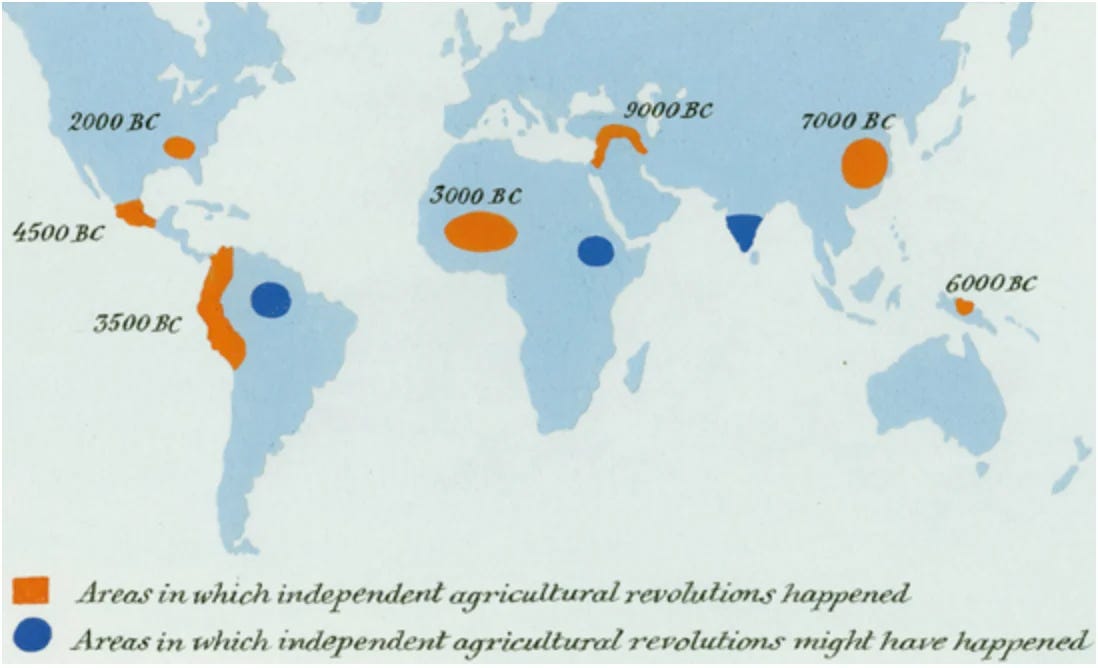
Geneticist David Reich has been asking climate scientists and archeologists how farming began. The consensus view is that humans have been intellectually capable of agriculture for fifty, a hundred, or three hundred thousand years, but it was never developed until the Holocene. Then, all at once, it was invented five, six, or seven times independently. According to Reich, this is, on its face, unbelievable.
How long is the fuse that connects agriculture in all parts of the world? Is it some suite of 300,000-year-old adaptations that lay dormant until the Holocene? Is farming a niche Homo sapiens can easily discover once the weather is right? Even Cremieux falls into this trap. But that is a model of epicycles built by those who wish evolution did not apply to the human brain and culture never spread from Eurasia.
The ultimate origins of agriculture are really about when and how we became human, hence the fog of war. The interview where Reich discusses farming is a national treasure because Dwarkesh Patel gets the man who wrote the book Who We Are And Where We Came From to say, over and over again, that we really have no idea. Even on the most basic questions: What makes our cognition different from animals? When and how did that evolve? What was that transition like?
Farming is simply the mystery the material record won’t let us ignore. The lack of art or symbolic thought in most of the Paleolithic can be swept under the rug (cf. the Sapient Paradox), but there is no question agriculture was a revolution.
The great coincidence of timing gets stranger when we look at the myths about the origin of farming. Cultures the world over credit (or blame) agriculture on women and supernatural serpents. What’s more, the same tabooed instrument is also often in the mix. This suggests a parsimonious model: a Paleolithic snake cult spread worldwide at the end of the Ice Age. With it traveled either agriculture itself or the ideas and institutions that made it a natural next step. This makes the fuse a few thousand years instead of 200,000. Mystery solved.
Triptolemus, spreader of seeds
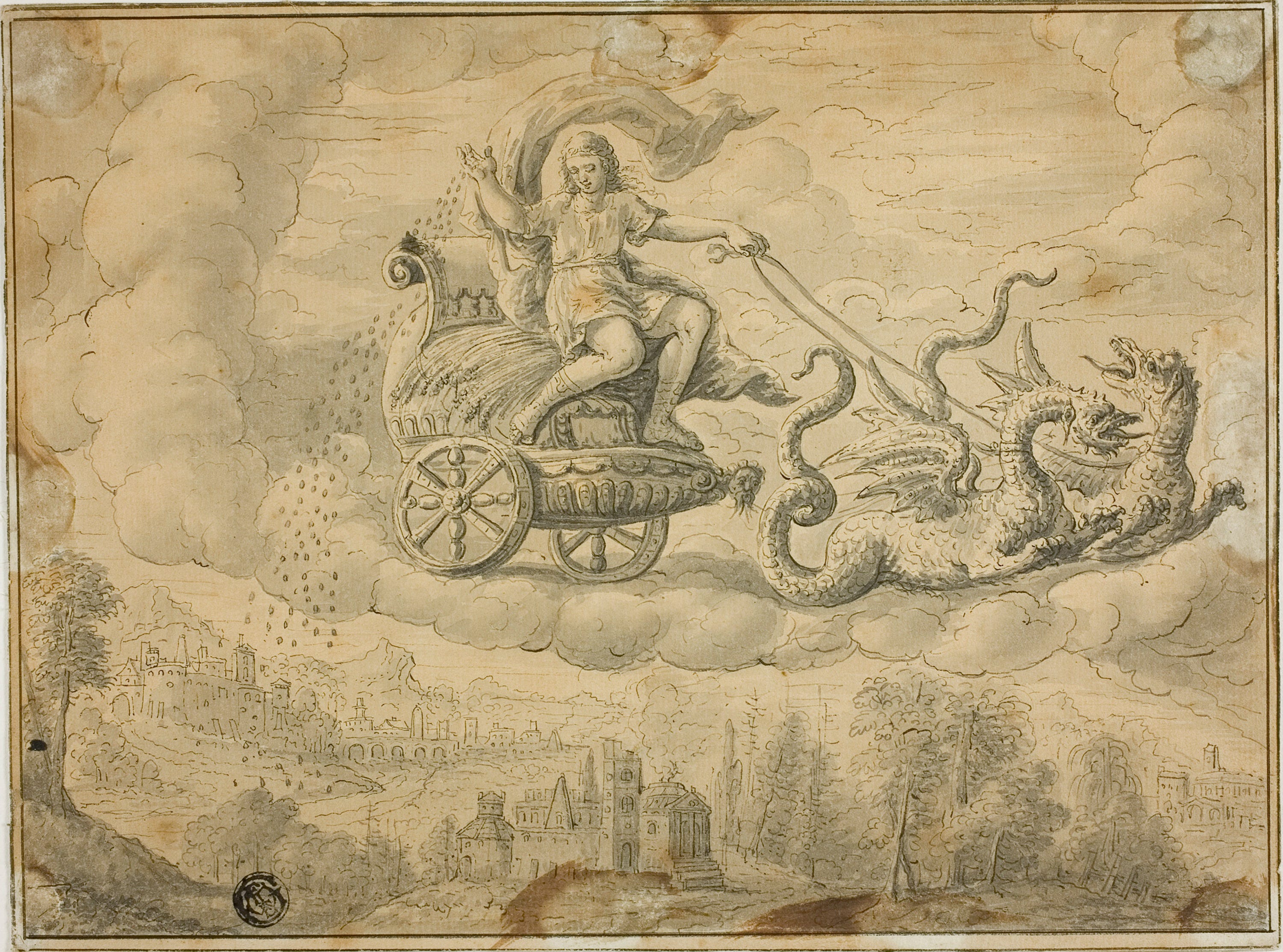
The word “cereal” is derived from Ceres, the Roman goddess of grain, whose name ultimately goes back to the Proto-Indo-European root ker-, meaning “to grow” or “to nourish.” So a bowl of breakfast cereal is not about grain so much as the generative life-force of the universe. To the Romans, Ceres is also the central figure of the Eleusinian Mysteries, of which Cicero waxed eloquent1:
“Nothing is better than those Mysteries, by which we have been brought out of a barbarous and savage mode of life toward humanitas and made gentle; and, since they are called ‘initiations’ / ‘beginnings,’ we have in truth learned the first principles of life; and we have received not only a way of living with joy, but also of dying with better hope.”
The Mysteries, then, taught who we are, where we came from, and what to do about it. All the talk about barbarism is not just an individual having a come-to-Jesus moment and becoming gentle. It is a myth about how civilization started: the ultimate origins of agriculture, religion, and the arts. Humanitas.
There is at least some truth in Cicero’s words. His ancestors eight millennia prior—the Anatolians who invented religion and agriculture—likely practiced similar mysteries. There is tantalizing evidence of an unbroken chain from cereal to Ceres to the cult at Göbekli Tepe. But we will get to that later.
Legend has it Ceres first taught the Mysteries to the mortal Triptolemus, along with agriculture and a charge to spread it across the world in his serpent-drawn chariot (pictured above).2 The Bible also hints at a spiritual transformation concomitant with agriculture. Eve eats the fruit of knowledge at the behest of a serpent, and then must till the soil. First, the knowledge of good and evil, becoming like the gods. Then, by the sweat of your brow shalt thou eat bread. The Roman parallel with Genesis is suggestive.3 But the Mysteries add something else: a ritual complex we can track.
New Guinea, receiver of seeds
Once Europeans started recording myths from the other side of the earth, they noticed similarities with their own. Consider this passage from The Folk-Tales of the Kiwai Papuans:
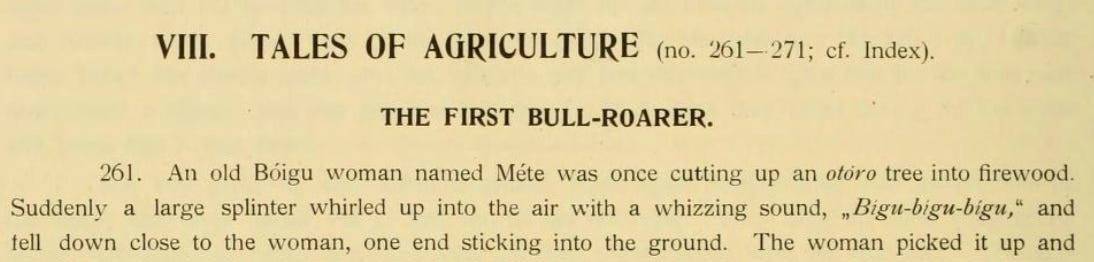
A snake-man then appears to Méte in a dream, telling her how to construct a bullroarer, and that she must douse it with post-coital semen and vaginal fluid. Thus slimed, its swing sings a yam field fertile. She then instructs the rest of the tribe; and so agriculture is established by a woman who learned the secrets from a supernatural snake.
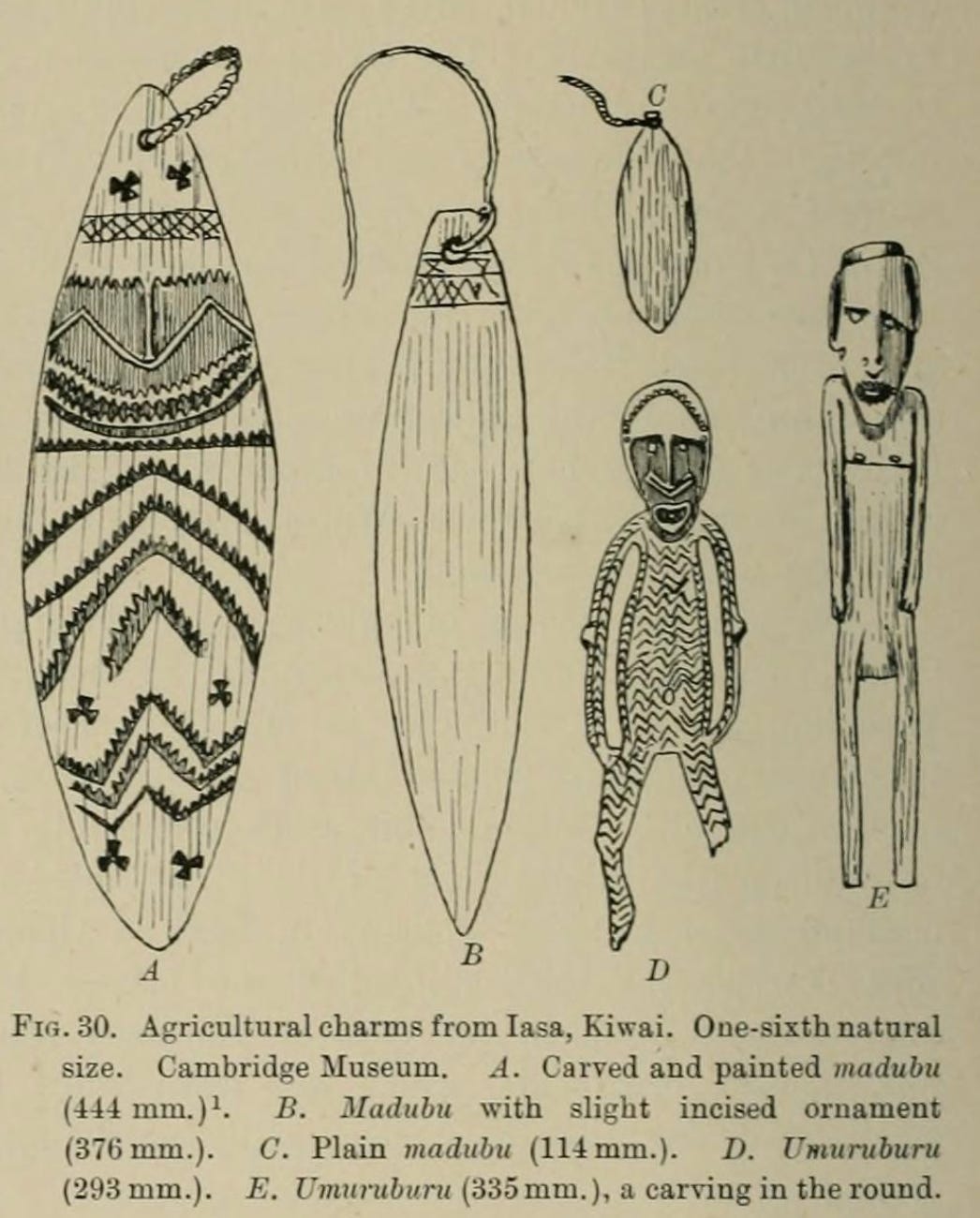
A bullroarer is a ritual instrument: a piece of wood tied to a string, then swung to produce a whirling sound bigu-bigu-bigu. Alfred C. Haddon (1902) provides us with a depiction of these agricultural charms:
Similar practices are found throughout the island. On the north coast, Yabim men whirled bullroarers while naming the dead to secure a “fine crop of taro”; in the highlands, the Nungon sounded one as men and boys ate the first harvest. In Sepik yam country, Kwoma bullroarers announced Nankwi—a female deity used to keep women from the men’s house—while Ilahita Arapesh initiates hid behind screens and made theirs speak as the “voices of the spirits” during yam-harvest ceremonies.4
The Nara used the bullroarer “to make the crops grow.” Some Buang families put bullroarers among seed yams in their planting baskets. In the far southwest, among the Upper-Bian Marind, ritual semen was carried home and smeared on plants, houses, and bodies. Women who saw the roarer were said to die. (What happens in the men’s house stays in the men’s house.)
Incidentally, the bullroarer was also used in Ceres’ Mysteries. For this reason, as well as myriad others, Joseph Campbell said the Papuan myth “is almost certainly a descendant of the same tradition that in the Mediterranean sphere produced the legends of Persephone [the daughter of Ceres] and Eve.” That is, in the deep past there was a fertility cult where women and snakes had some special relationship to agriculture. Perhaps those Neolithic priestesses even fertilized the soil with a cum-soaked bullroarer or proffered libations of poppy. The particulars are lost to us but we do have cultural memories in the myths of Eve, Ceres, and Méte.
Campbell is not some cheap hyper-diffusionist jousting at coincidences. He is most famous for the Jungian tome The Hero with a Thousand Faces. However, in this instance, he finds the evidence for a shared prehistoric root overwhelming. Similar minds could not have produced such similar tales for the origin of agriculture. There must be a prehistoric connection.
This is not to say that a prehistoric Triptolemus brought yams to New Guinea. Rather, the snake cult contained the kernel of agriculture. This could have been indirect, such as a social structure that made it easier for the tribe to plan their next season. It could be the idea of sedentism or a language with pronouns or matriarchy or patriarchy or better calendars or any number of things. The point is that the agricultural revolution in New Guinea is derivative of cultural developments in Eurasia.
Africa, receiver of goat, sheep, cattle, and… seed?
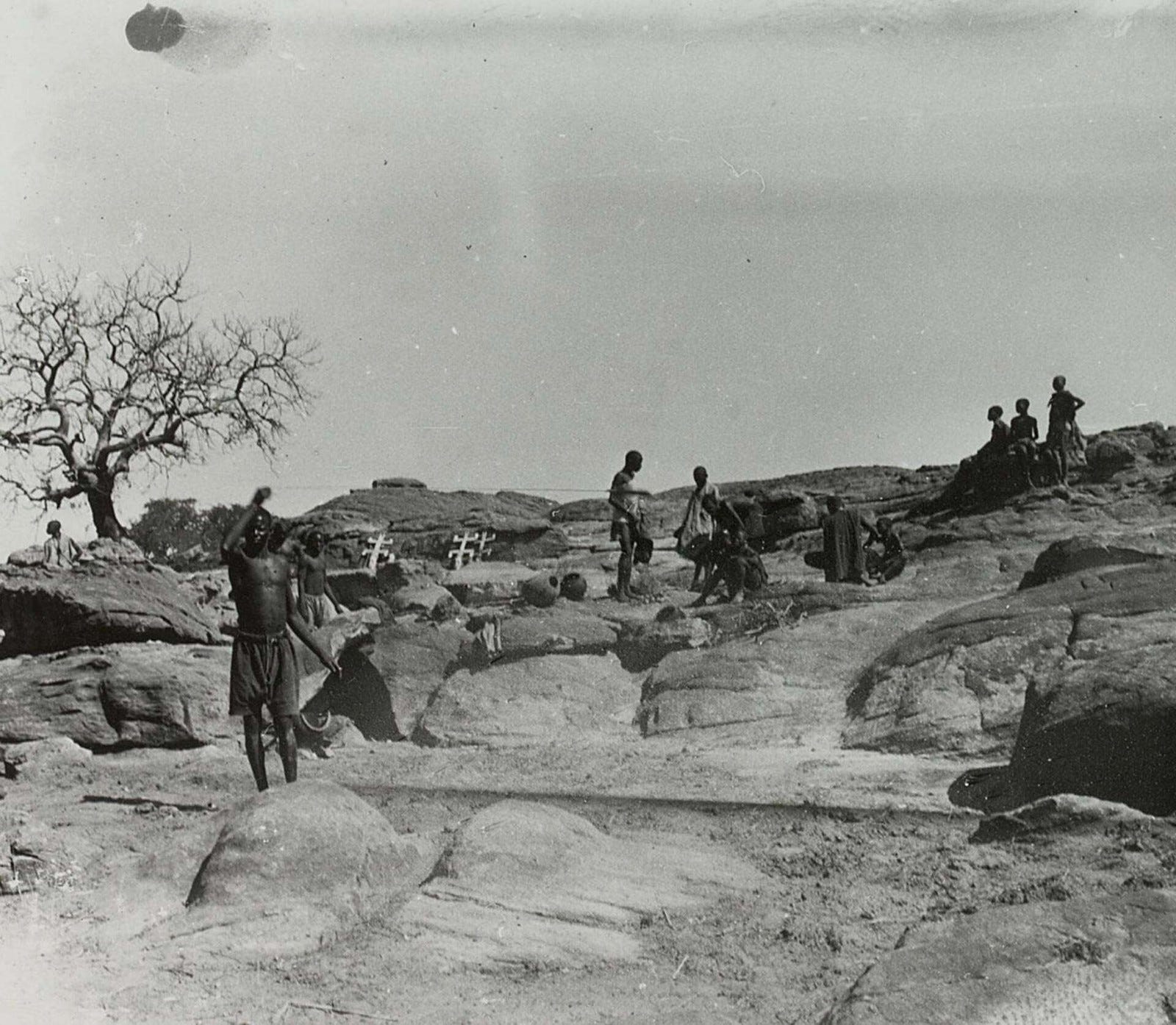
“At harvest time the trusted men of the Bali chief run from homestead to homestead, from plantation to plantation, letting a piece of wood, the bull-roarer, whizz through the air on a long cord, in order to bar evil spirits from entering. These men may be seen by no woman.” Frobenius, Die Masken und Geheimbünde Afrikas (1898), pp. 164–165
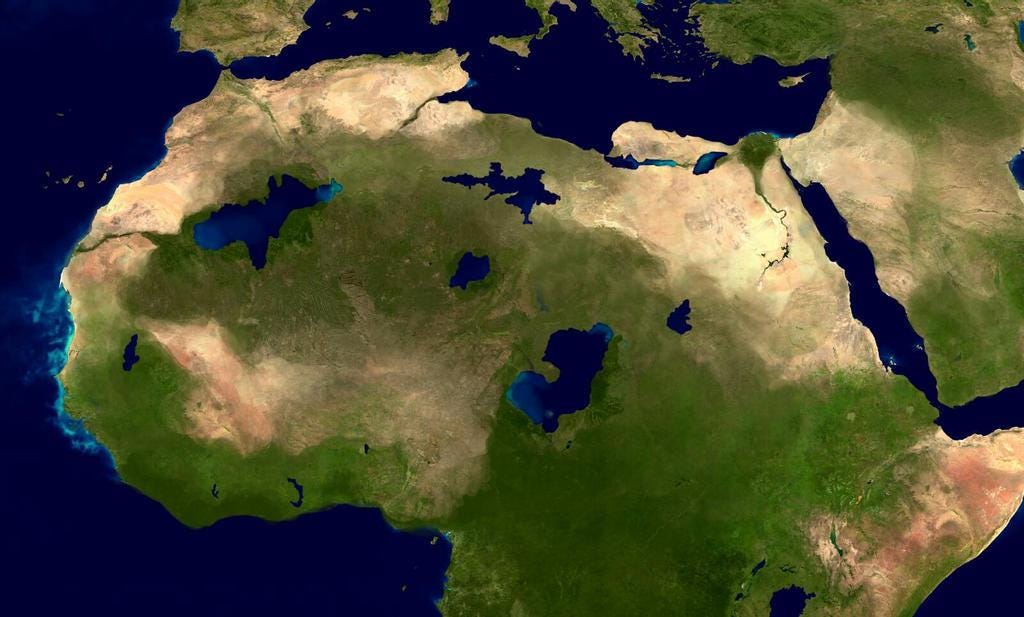
Academics traditionally treat Africa as hermetically sealed—all 100% organic, indigenously sourced culture. It is anybody’s guess why the Green Sahara would have been an impenetrable barrier, but we will give them their superstitions.
Here on planet Earth, however, farming in Africa seems to be an import. Just as in New Guinea, the bullroarer is associated with agriculture, women are credited with its first use, and yet are now forbidden to see it.
More concretely, the first farmers in Africa were European migrants in Morocco. 7,400 years ago, they brought emmer wheat, barley, lentils, peas, fava beans, sheep, goats, and cattle. The second farmers in Africa were the Ancient Egyptians, who adapted the Levantine package to the Nile delta about 7,000 years ago.
The third farming tradition started in Mali 4,500 years ago with the domestication of pearl millet. We don’t have any DNA from this group, but we do know they were cattle, sheep, and goat herders. So there is no need to invoke some great coincidence as if two lineages separated by 100,000 years suddenly had the same idea. The first millet farmers were already living like Levantines and likely had contact with the farmers from Morocco5. African rites of agriculture suggest diffusion as well.
(At this point, cultural sensitivity obliges me to ask any women to please stop reading—photos of the bullroarer follow.)
In the Cameroon Grassfields, a woman who glimpsed a bullroarer during the sowing festival would never bear another child. So the women danced facing away, hands pressed over their eyes, while young men ran leaping through the farms swinging the roarers over the new seed. Far to the South, in Namibia, the king sent out “cloud-callers” armed with bullroarers to bring the rain for crops. In northeastern Nigeria, the roarers sounded at night in a harvest rite where the god “takes hunger and throws it away into the bush,” the women shut indoors. In central Nigeria, the bullroarer was the cry of Dodo, whose senior spirit governed the weather at sowing and harvest. Dodo cultists admitted that for them, terrorizing the women was a main object of the rites. Similarly, among the Yoruba, when the roarer spoke as the god Oro, every woman in town locked herself indoors on pain of death.
The Bobo peoples of West Africa marked the start of the sorghum harvest with a priest’s iron bullroarer. The Bwa of Mali said the god embodied in their iron bullroarer brought them agriculture. His cult organized the clearing, sowing, and harvesting of fields.
The serpent is here too. The Dogon of Mali say death entered the world by transgression: the first ancestor sinned, was sacrificed, and rose again as a serpent. Every sixty years, they carve him anew, a wooden serpent called the Great Mask, and the bullroarer that bears its name drones with his voice. Interestingly, the masks belonged to the women first, before the men seized them and barred women from even looking upon them or the bullroarer.6
Some of the myths are strikingly similar to the account we hear in Genesis. According to the Dinka, in the beginning the heavens lay just above the earth. The two were joined by a rope, so that people could climb up and down to Divinity (Nhialic) as they liked. There was no death. The first man and woman, Garang and Abuk, were fashioned from clay, and God gave them a single grain of millet a day. Enough to survive, but they were hungry. Abuk wanted more and contrived to plant her own garden. As she raised her long hoe high to sow the contraband, she accidentally struck Divinity. Offended, Nhialic cut the rope joining heaven and earth, withdrawing permanently. Henceforth, people had to labor for their food, could no longer reach God freely, and suffered sickness and death.
So, just as in the Near East where farming was invented, the first man and woman are made from clay, live an Edenic existence without labor, break a food taboo, are cast from god’s presence, then must live by the sweat of their brow. Interestingly, Abuk, their Eve, is represented as a snake. The Dinka are among the tallest peoples in the world, savannah pastoralists of the South Sudan. The Efe pygmies, hunter-gatherers in the Congo jungle, tell a creation myth just as strikingly similar to Genesis, with a Jaynesian twist.
I don’t see how all of these myths and rituals could be independent from developments in the Levant. A recent genetics preprint detects three “back to Africa” waves from 14–3 kya, affecting even extremely isolated groups like the Khoisan7. I propose these migrants did not arrive as blank slates, but brought culture of their own, including the Snake Cult. Africa is an independent cultural zone by academic construct, but this is in defiance of a mountain of evidence.
The first farmers
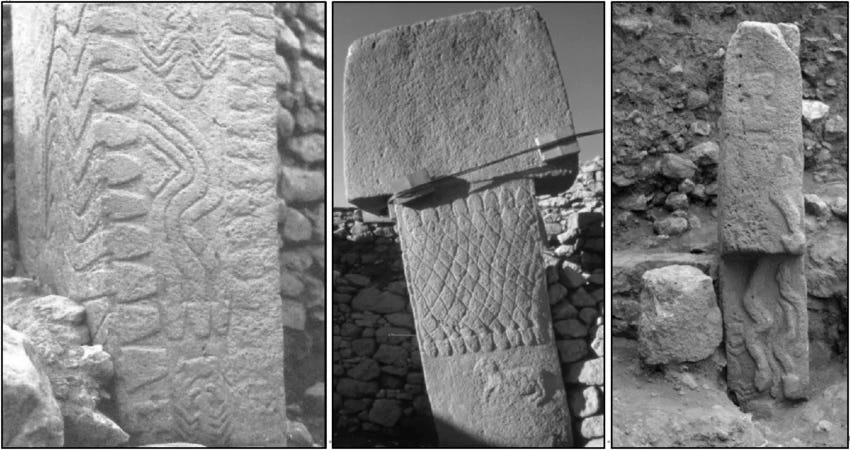
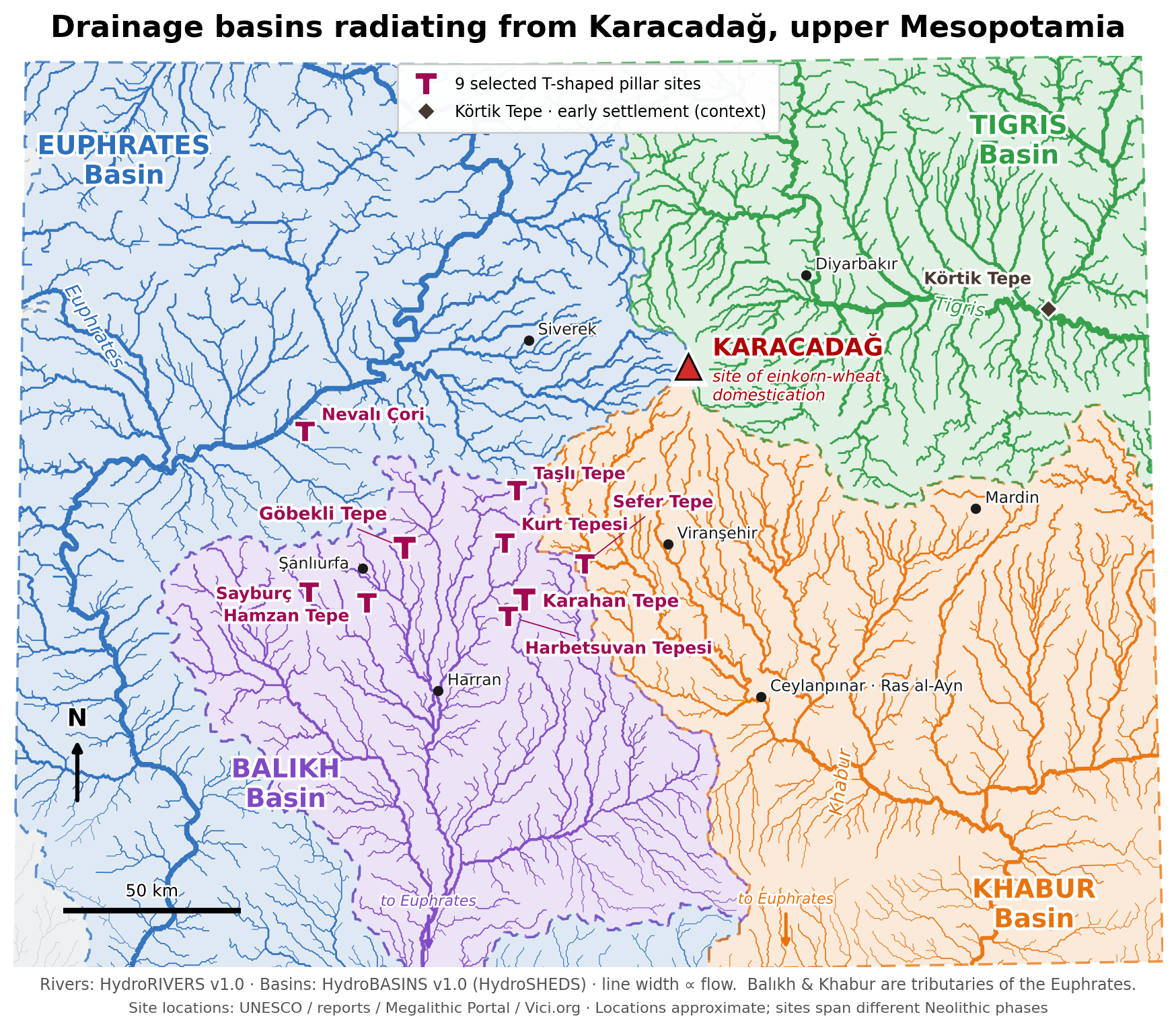
Given the similarity of agricultural myths from New Guinea to Rome to Africa, it behooves us to look back to the world’s first farmers. Was the Fertile Crescent frothy with bullroarer-swinging snake cultists? Yes, actually. And right where Genesis says they should be.8 Fifty miles from where wheat was domesticated (Karacadag) lies Göbekli Tepe, the first temple, which seems to have been dedicated to snakes, by far the most common animal carved on the pillars. And though Göbekli Tepe is only 5% excavated, they have unearthed what looks like a bullroarer. This is not uncommon for the region. Körtik Tepe—built 10,700 BC, the oldest Neolithic site in the world—also has them:
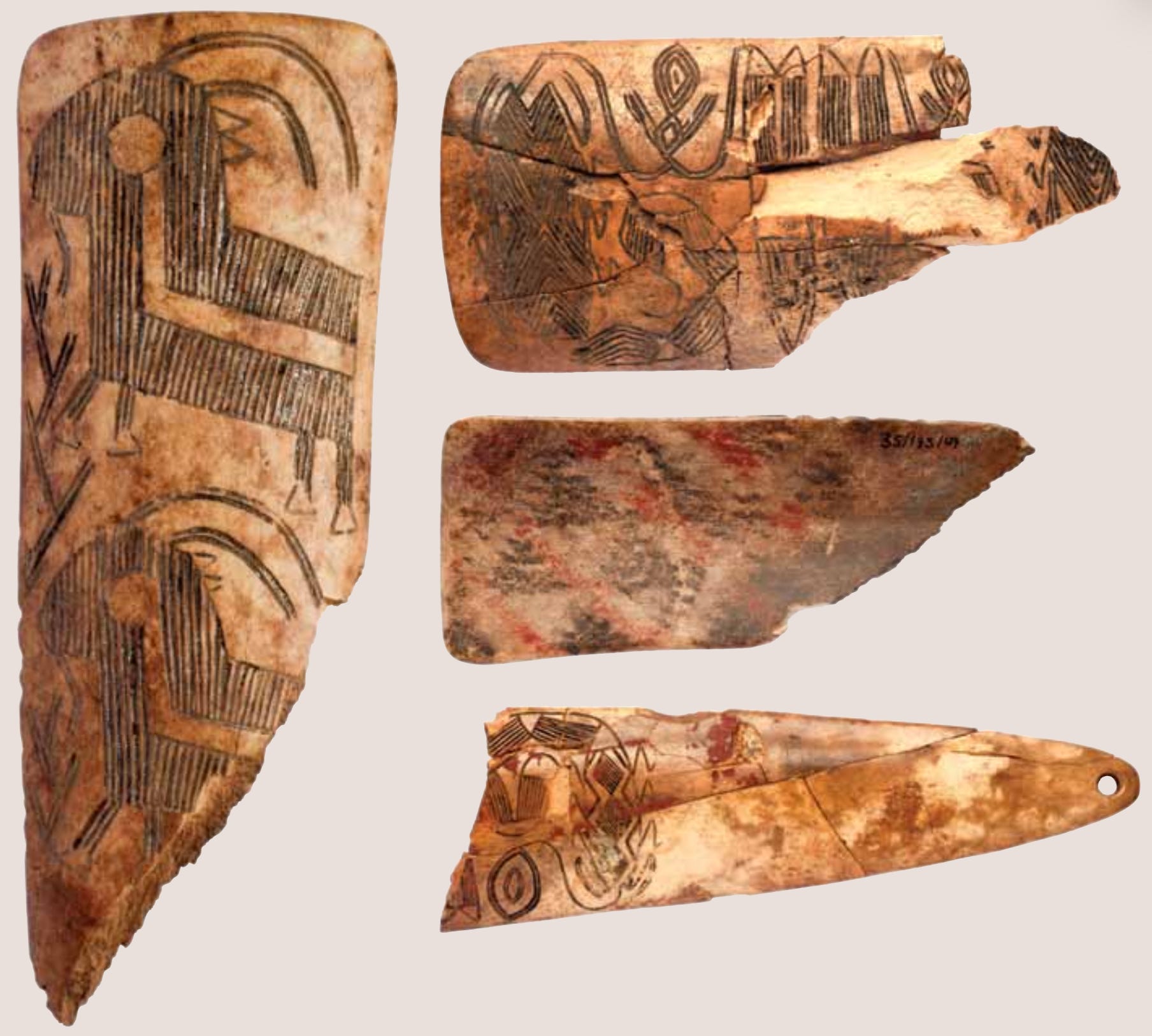
These are the hunter-gatherers at the cusp of the first farming society. Men from Eden about to open Pandora’s box with the help of women, bullroarers, and a trickster serpent. I think their traditions spread into Africa and Papua New Guinea, which is why they started farming and also why their myths and Mysteries echo those in Athens and Jerusalem.
America, another testament of the primordial serpent
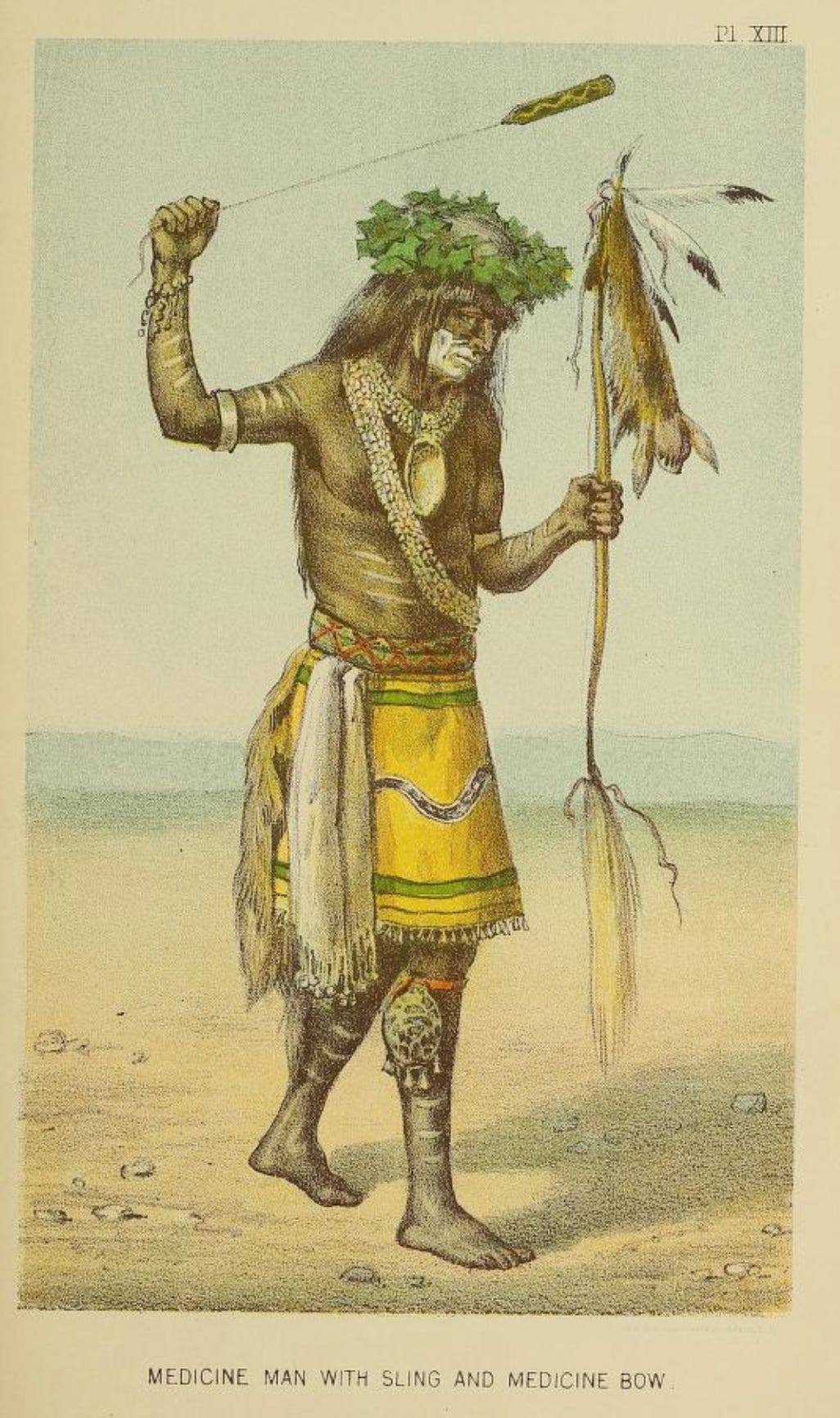
On the high desert mesas of northern Arizona, Hopi priests dance with live rattlesnakes in their mouths to bring rain to the corn. When John Bourke watched at Walpi in 1881, a warrior trailed the snake priests whirling a bullroarer. The medicine-men explained, “They compelled the wind and rain to come to the aid of the crops.”
In New Mexico, Zuni priests whirled it to rouse rain-making spirits. The Tewa of the Rio Grande whirled theirs in kivas, “where women could not see them.” In Apache country, the tzi-ditindi (“sounding wood”) had to be cut from a pine struck by lightning. In the drought of 1884, medicine-men desperately carried it through the fields to bring rain. In southern Arizona the O’odham celebrated harvest with bullroarers decorated with symbols of maize and rain.
Along the Pacific, the roarer guarded the Mysteries. Among the Luiseño and Diegueño of Southern California, boys and men underwent toloache initiation while the bullroarer warned women and the uninitiated away. Among the Kato, north of San Francisco, boys were shut in the dance-house for months while “the women at home believed that the bullroarers were the voices of the ghosts.” Pomo women likewise took the roar for the voice of the dead; initiated men knew it as Thunder-man, and whirled thunder-sticks at the four corners of the assembly-house while the high priest prayed for rain. On Vancouver Island, Kwakiutl men climbed secretly onto the rooftops and whirled bullroarers as the voice of the cannibalistic spirit that was about to possess the novice.
Five thousand miles away, deep in the Amazon, the Kamaiurá say the sacred flutes belonged to the women at the beginning of the world, until the twins Sun and Moon routed them with a bullroarer. The women fled at the roar, the men seized the flutes, and no woman has been permitted to look at them since. To maintain the current order, men have license to gang rape any woman who sees the bullroarer. It’s a strange story to be told at all, crediting women with the invention of something that is now forbidden. Stranger still, it pops up next to the same instrument in the Amazon, Africa, and New Guinea.
Among the neighboring Wauja, who remember the same coup, the bullroarer comes out when the pequi fruit ripens: men spin roarers while the women stay locked indoors, forbidden to look. The Mehinaku say the bullroarer spirit owns the gardens outright, and give it a three-day feast.9
Now, there is a lot of variety in how the bullroarer is used. It is not primarily associated with agriculture or everywhere tabooed to women. But there are undeniable similarities. In the 1920s, Edwin M. Loeb, an anthropologist at Berkeley, noticed these between North and South America, and then later the rest of the world, arguing:
“There is no psychological principle involved which would necessarily group these elements together, and they therefore must be regarded as having been fortuitously grouped in one locality of the world, and then disseminated as a complex.”
The original spin
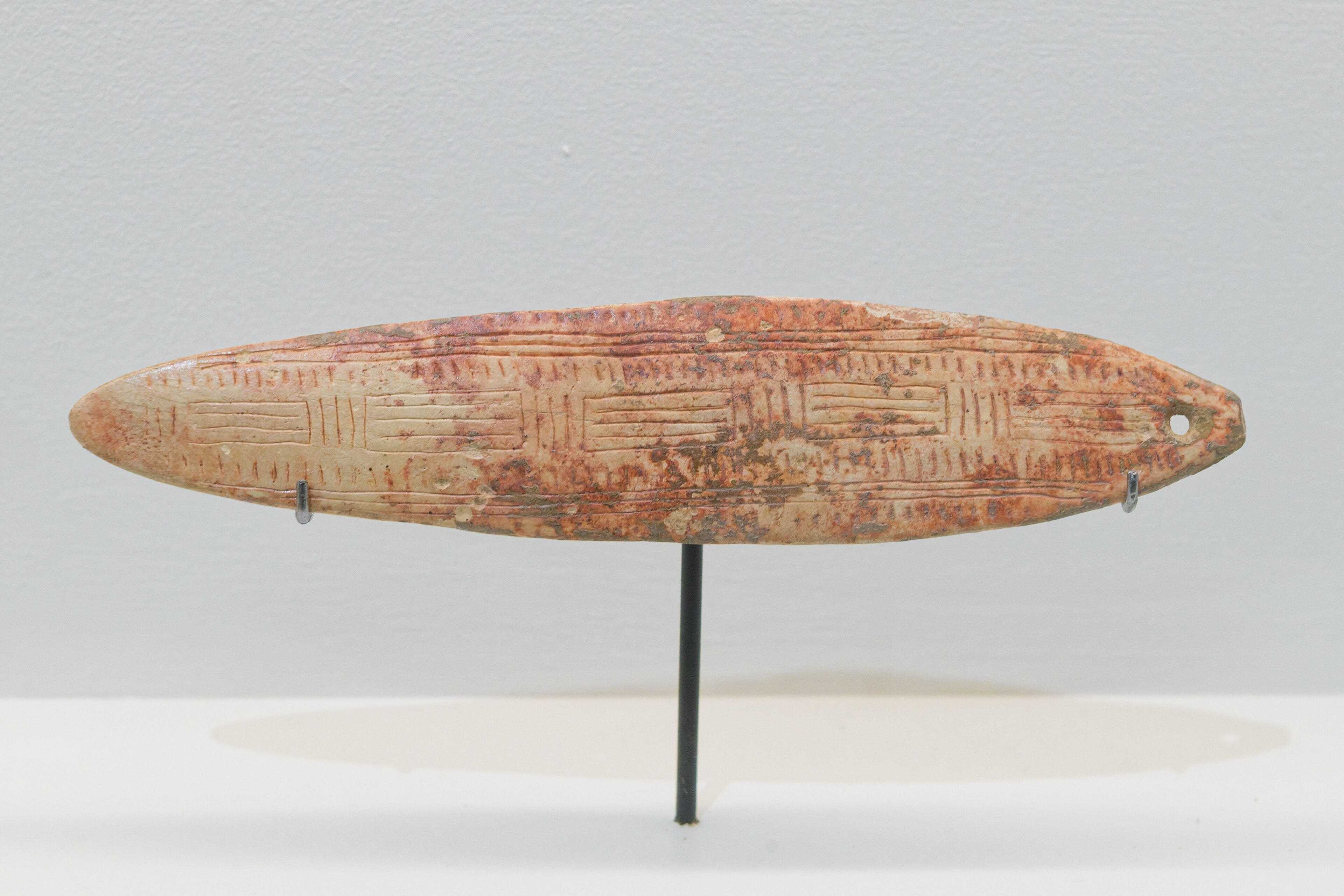
The oldest bullroarers are not found in the Fertile Crescent. A year after Loeb argued for monogenesis of bullroarer cults, the first Paleolithic bullroarer was pulled out of a cave in France. Dozens more have followed, largely in Basque country, though there are some debated specimens scattered across Europe all the way out to Ukraine. You can peruse them on my bullroarer atlas (which has 1,000-and-counting attestations globally). The oldest bullroarer candidates are:
Germany — Vogelherd Cave (c. 38,000–32,000 BC)
Slovenia — Potočka zijalka (c. 33,000 BC)
France — Brassempouy (c. 29,500–26,500 BC)
Czech Republic — Pavlovian Moravia (c. 22,000 BC)
Each of these is debated. The sure finds are from the Solutrean and Magdalenian periods starting about 20,000 years ago. At any rate, there is no mystery how a cult that started in Ice Age Europe would travel to the rest of the world. These are the same people that domesticated dogs, which made it to all parts of the globe. The Snake Cult theory of agriculture doesn’t even need to posit a new route of cultural diffusion.
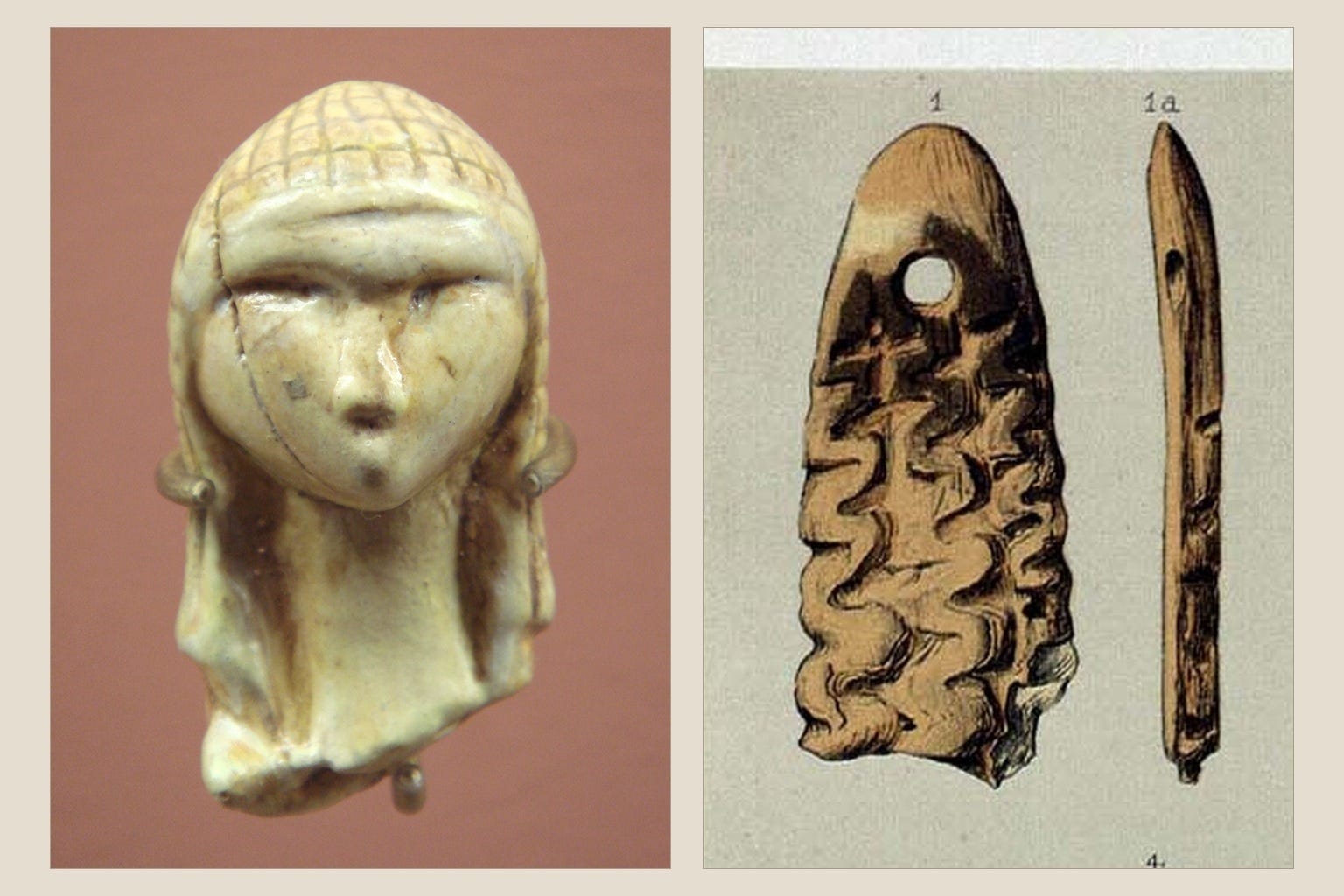
A European root of the bullroarer cult may also explain the myths about women originally owning the cult. The Lalinde bullroarer, for example, shares a cave with 11 female silhouettes carved into the wall. There is also the serpent-carved pendant (bullroarer?) unearthed in the same cave as the Dame of Brassempouy, one of the oldest busts in the world.
At any rate, there were undeniably striking gender dynamics in the Paleolithic. Did you know that before 10,000 years ago depictions of humans are extremely rare? The most notable exception is Europe, but even then it is almost all women (1, 2, 3, 4, 5, 6, 7). It’s a strange imbalance to persist for some 30,000 years (from roughly 40–10 kya). Imagine if the first 30,000 years of film showed almost exclusively men. That would need some explaining, no? I have written at length about how if social intelligence made us human, women would have been human first. I think the bullroarer cults today remember those times in human development when women started to organize themselves like modern humans and domesticated our species. This domestication package spread. It was mostly directed at humans, which was the object of the cult (taste the Knowledge of Good and Evil, Adam), but domesticated humans domesticate plants and animals. Wherever the snake cult spread, humans soon began taming the natural world.
And so, curiously, the ancients may be more right than Reich about who we are and where we came from. It is humbling to think that even with the benefit of thousands of years of debate, the printing press, full genome sequencing, ten thousand archeological digs, the scientific method, and billions more people we have somehow confused the question of whence humanitas came. This can only happen if human origins are a collective blind spot, a load-bearing taboo.
This is obviously much more than you need to accept to explain the coincidence of farming, but it is a romantic vision of our species that answers many mysteries. And it must be said the origins of agriculture are intractable precisely because they are intertwined with the origins of humanitas. Consider the mundane version of my model. About the same time as dogs spread the world over, mystery cults did as well, and these were a cultural stepping stone to agriculture. Then consider all of the coincidences that keep stacking up about snakes and bullroarers and agricultural rites. Why then the insistence on independent invention?
The sun revolves around the Earth, and humanitas hails from Africa
The world’s agricultural revolutions are claimed to be independent because the alternative is that much “indigenous” culture has roots dangerously close to the Caucasus. This is every bit as damaging to the ideology of modern academia as the solar system was to the Catholic Church.
I recently reviewed the paper “Worldwide patterns in mythology echo the human expansion out of Africa.” Despite its title, it presents evidence that all the world’s mythologies have elements that go back to Ice Age Europe. It offers zero evidence to support the Out of Africa claim in the title!
There is a standard move for academics who find worldwide cultural similarities that can’t be explained by chance. Simply assert diffusion after Out of Africa is impossible, and that the root must therefore be in Africa more than 50,000 years ago. For example, folklorist d’Huy does this with the origins of the worldwide motif F-38:
Women formerly possessed sacred knowledge, sanctuaries, or ritual objects that are now forbidden to them—or women attempted to obtain that knowledge or those objects.
Remarkably, the forbidden ritual objects are often the bullroarer, and a decade later he made this explicit in a paper arguing the bullroarer complex precedes the Great Migration. Folklorist Yuri Berezkin says the same of the primordial bullroarer cult10. But if this package diffused from Africa, why are all the earliest samples—by ten thousand years—in Europe? Not only of bullroarers but flutes and Venus figurines as well. Imagine if Africa had 30,000 years of Venus. Surely that would be presented as evidence the myths remembered some long-lost social standing of women. As it stands, there is no archeological support for d’Huy’s model, only an article of faith that humanitas hails from Africa.
Harvard philologist Michael Witzel pulls the same trick in The Origins of World Mythology. He argues the world’s creation myths are so similar they share a common root11. Much points to Ice Age Europe, which he claims is impossible because there could not have been diffusion from there to the rest of the world. But what about dogs? They were domesticated in Eurasia and made it to the Americas, Africa, and Australia. The barriers to diffusion are trivially false.
This is standard practice among long-range folklorists. Any global myth is thought to hail from Africa before the Migration. This is, quite simply, bullshit. Stories don’t last 100,000 years12. In every case, Ice Age Europe is the better choice for a root. The academy wasn’t always so confused. Just look at the grand theories of old:

The graphic above is from Swadesh’s 1971 classic The Origin and Diversification of Language. Drawing on linguistic and archaeological evidence, he argued that the languages of technologically dominant cultures spread across the world, swamping those at the margins. He placed the ancestry of every surviving language in a Paleolithic radiation from western Eurasia, with Basque-Dennean at its heart.13 Now, preempting any comments that I am laundering the ravings of some crank Nazi-sympathizer, it must be said that Swadesh was a giant in his field and a card-carrying communist. So he looked on the horrors of the 20th century and thought, millions more must die—but in like a cool way.
The point is that before Out of Africa the root of human culture was thought to go back to when humans started to act human, and that is surprisingly late and mostly outside of Africa (again, cf. the Sapient Paradox).
This view has been complicated as genetic studies show deep forks in the human family tree. Because of this genetic separation, it has been widely assumed that evolution essentially stopped 50,000 or even 300,000 years ago, and continents have been largely culturally isolated. Neither assumption holds; we need a model that accounts for both continued evolution and cultural diffusion.
Just as the spread of dairy cows drove the evolution of lactase persistence in both Europe and Africa, more complex language (or a snake cult) could have spread and selected for sapience—including the wherewithal to invent agriculture. The shared ancestors of all humans today may not have been fully human. My next article will go into more detail on that gene-culture model.
Göbekli Tepe revisited
The paper announcing the bullroarer at Göbekli Tepe is a monument to the epistemic nihilism of modern archeology. The authors made a replica of the putative bullroarer and spun it. Out came the bigu-bigu-bigu of the snake-man droning the semen-stained mysteries of the Kiwai. Dodo belted the sowing song of the Uukwaluudhi; the skies burst open, pouring forth rain. Women fled, covering their eyes. Dionysus appeared to the researchers in the form of a child, begging to be torn limb from limb.
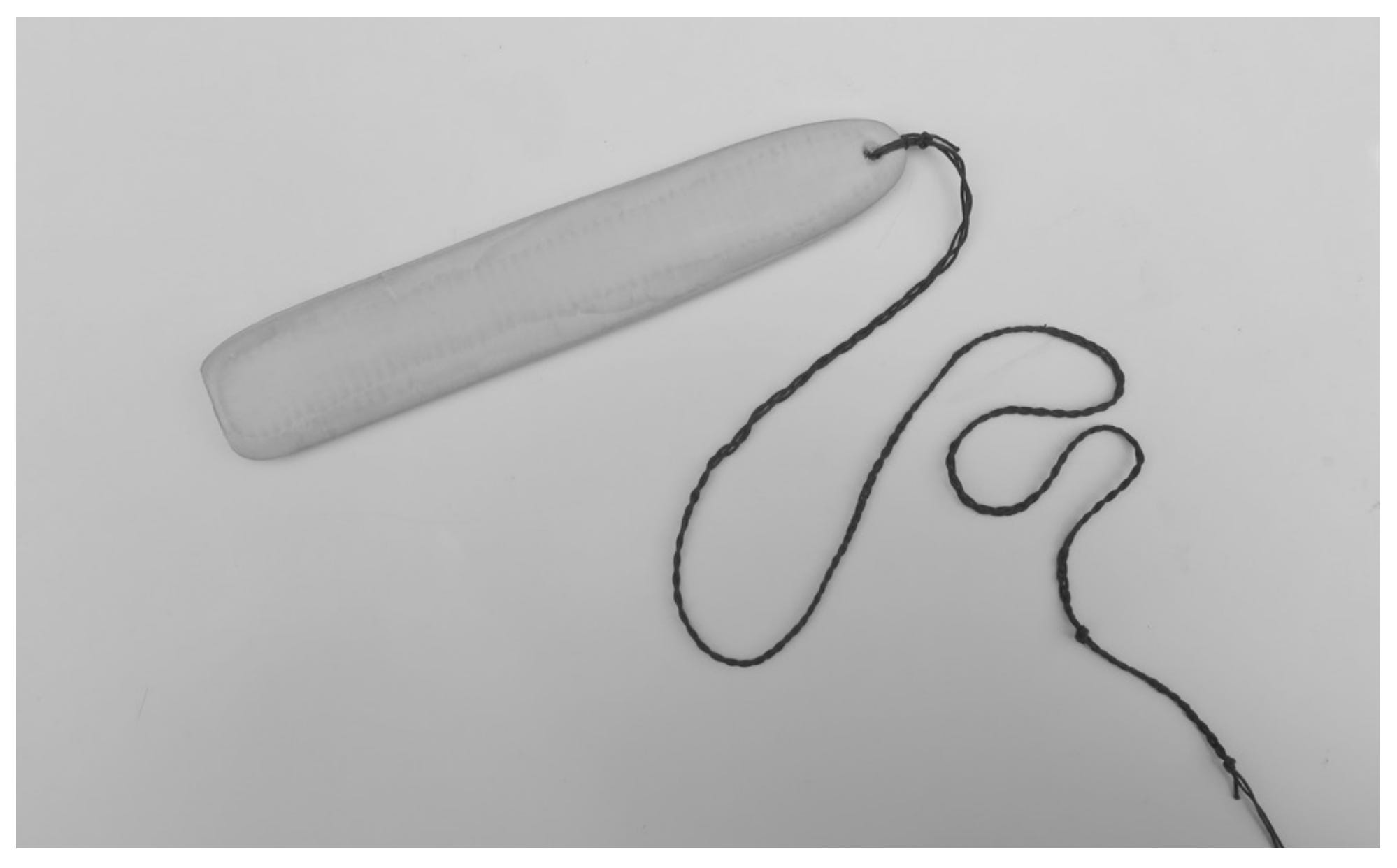
But the voice of the gods fell on deaf ears. The thesis of the paper is that it’s impossible to know anything for sure. It looks like a bullroarer and sounds like a bullroarer, but can we ever truly be sure? Maybe it was a friendship bracelet or a wind chime?
“The point of the present contribution is not to show that Neolithic art in general is not understandable. But there has to be a basic awareness of the fact that not every depiction is ‘readable’ beyond doubt, and that such depictions naturally should not be used as evidence for far-reaching interpretations.” ~A Decorated Bone ‘Spatula’ from Göbekli Tepe. On the Pitfalls of Iconographic Interpretations of Early Neolithic Art.
The above quote is the only hint in the paper that identification as a bullroarer would have far-reaching implications. It does not even mention the role of the bullroarer in the Greek and Roman Mysteries—the direct descendants of the Anatolian Farmers—or the connection of the bullroarer to agricultural rites in Africa, America, and New Guinea. Note the same authors are willing to speculate about cultic bird dances at Göbekli Tepe based on much flimsier modern connections.
Generously, one could say the authors simply don’t want to get out over their skis, but you just know that if they found a 12,000-year-old bullroarer in Australia they would be falling over themselves to demonstrate ritual continuity. The article would not be titled On the Pitfalls of Iconographic Interpretations of Aboriginal Art.
Conclusion
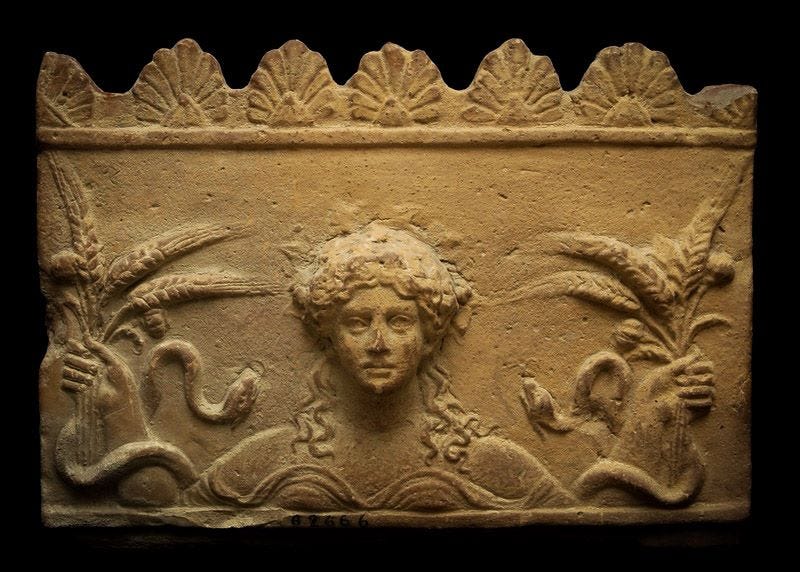
The Romans said Triptolemus learned the Mysteries then spread agriculture on a serpent-drawn chariot. The Papuans say a snake man taught them how to use the sacred bullroarer and plant yams. Bullroarer cults are connected to agriculture in Africa and the Americas as well, often with the same prohibitions against women. A bit of diffusion near the end of the Ice Age explains all of this.
Just looking at Western history, there is evidence for continuity of a mystery cult from Göbekli Tepe to Greece. Going back further still, the earliest known bullroarers are in Ice Age Europe; the diffusion of a Paleolithic snake cult from there completely resolves why agriculture popped up all over the world at roughly the same time. This is not even proposing a new wave of cultural diffusion. The dog was domesticated in Paleolithic Europe or Siberia, then spread worldwide. Likely, the Snake Cult took the same route at roughly the same time.
Beyond the West, this would mean the world shares what anthropologist Jean Servier called “an initiatory tradition and primordial teaching”. Mythic women like Méte, Abuk, and Eve are in fact memories of when humans started to plant yams and plow the fields. The legends agree that agriculture pales in comparison to the Mystery at the heart of the snake cult. Archeologist Jacques Cauvin called it the Revolution of Symbols that made agriculture possible. I think Genesis is more apt with the fruit of knowledge of good and evil. The Fall was women creating a culture that required self-reflection. This spread from a Basque-Dennean or Gravettian root to the rest of the world.
The next article on the genetics of sapience will touch on much of the conversation between Patel and Reich, including Patel’s aside about the breakdown of the bicameral mind. They are both busy people who do not have time to study the ways of the bullroarer. But the world of strange new ideas is small and they could see this if you share it broadly.
For more on the diffusion of the bullroarer from New Guinea to Australia:
Nggwal: The Cult That Crossed Sahul

New Guinea and Australia leap out at you on the bullroarer atlas. Of 1129 unique attestations worldwide, 336 are found there—a full 30% of the global corpus. In both places, the bullroarer complex is treated as ancient because it crosses all language families and ways of life. It is used in similar ways by fishers on the coas…
Isocrates says essentially the same. Demeter gave Athens two supreme gifts: grain and the holy rite.
“Now, first of all, that which was the first necessity of man's nature was provided by our city; for even though the story has taken the form of a myth, yet it deserves to be told again. When Demeter came to our land, in her wandering after the rape of Kore, and, being moved to kindness towards our ancestors by services which may not be told save to her initiates, gave these two gifts, the greatest in the world — the fruits of the earth, which have enabled us to rise above the life of the beasts, and the holy rite which inspires in those who partake of it sweeter hopes regarding both the end of life and all eternity.
Our city was not only so beloved of the gods but also so devoted to mankind that, having been endowed with these great blessings, she did not begrudge them to the rest of the world, but shared with all men what she had received. The mystic rite we continue even now, each year, to reveal to the initiates; and as for the fruits of the earth, our city has, in a word, instructed the world in their uses, their cultivation, and the benefits derived from them.”
Greek tradition also gave Dionysus a parallel civilizing mission. Diodorus distinguishes several Dionysi: one was credited with first yoking oxen and sowing seed; another traveled through the inhabited world with women armed with thyrsi, teaching his rites and initiating the pious into his mysteries (Library of History 3.64.1–7; 4.4.1–2). Euripides likewise presents Dionysus arriving at Thebes after establishing his khoroi and mysteries throughout Lydia, Phrygia, Persia, Bactria, Arabia, and Asia, and declaring that after settling Thebes he will move on to another land (Bacchae 13–25, 47–54).
Archeologist Jacques Cauvin, for example, connected Greek and Hebrew traditions to a spiritual change before agriculture, wondering if they were a memory of the Pre-Pottery Neolithic.
The roar could also hold back the harvest until the crop was ripe and the feast ready. On Wogeo, it was the voice of a lewa monster that locked up the chestnuts for a month, until the ban was lifted and the crop picked; masked Mekeo men did the same for coconuts; and at Waima, masked kaivakuku swung theirs by night while policing such garden closures. Break the ban and they raided your house, killing your pigs and dogs.
Jukanti et al. (2016), “Crops that feed the world 11. Pearl Millet…” — Food Security 8:307–329. Its domestication discussion says that cereal cultivation spread from the Near East into North Africa, after which drying forced farmers south, “abandoning the temperate cereals and starting to domesticate more favourable tropical grasses.” It identifies pearl millet as the first such grass domesticated along the advancing desert’s southern borders.
See also Patrick Munson arguing in 1976 that pastoralists would have been acquainted with agriculture. Wheat would not grow in Mali, so they adopted local grasses. He even named the place where he expected the domestication to happen. Thirty-five years later the earliest millet was excavated there.
Marcel Griaule also links the bullroarer to the agricultural rites of the Dogon in Mali.
Or, if you don’t like preprints, consider why R1B is prevalent around Lake Chad.
The Bible tells us four rivers flow from Eden: Pishon, Gihon, Tigris, and Euphrates. The first two are mythic rivers that can’t be identified (though some do try). But if we look to the headwaters of the Tigris and Euphrates, we indeed find the volcano on whose slopes wheat was first domesticated. This detail survived for 9,000 years before being written down by Moses (or the Jahwist, if you prefer the scholarly answer).
When Opus 4.8 came out, I took it for a spin by asking for the basins around Karacadag. Indeed, many rivers flow from there; however, both Khabur and Balikh ultimately empty into the Euphrates. It is still impressive that the very mountain is right on the edge of 2/4 of the basins that the Bible mentions.
For another possible location, see Christian Gonzales’s We Found Eden.
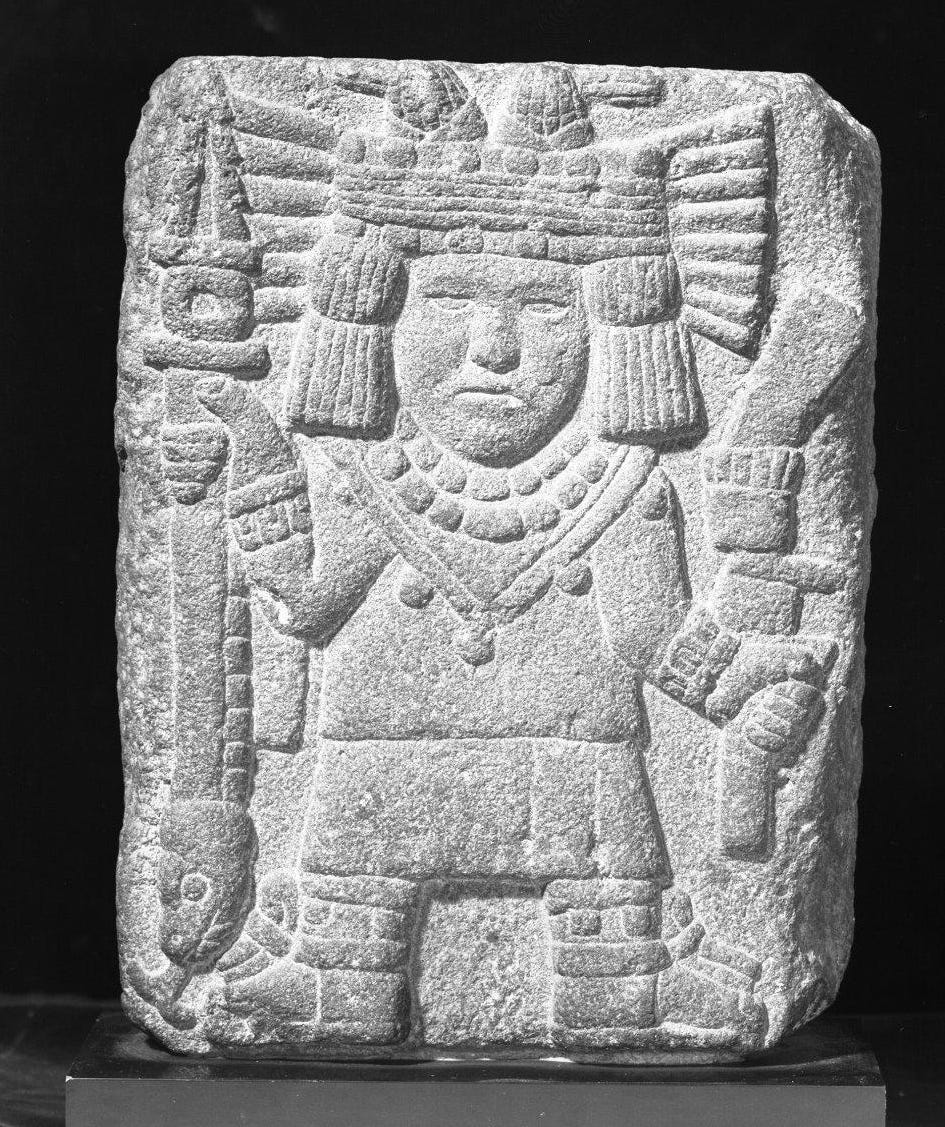
There are many other examples that space doesn’t allow me to include. An honorable mention goes to the Aztec goddess of corn called Seven Serpents (Chicomecóatl), though the Florentine Codex simply glosses the goddess “another Ceres.” Below she is sporting a corn-cob hat and holding a rattlesnake-shaped staff used to penetrate and fertilize the soil.
“It may be supposed that male rituals associated with institutionalized opposition between the sexes originated in Africa…”
Witzel points in part to the role of serpents in precipitating the age of man.
Often a date significantly older than Out of Africa is given. This is partly because there were several migrations, and partly because these scholars place the origins of global myths at the genetic root of mankind, significantly earlier than Out of Africa.
Incidentally, Basque Country (of Basque-Dennean fame) is a hotbed for Ice Age bullroarer finds, which you can explore in the bullroarer atlas.
Seems like your theory needs to explain why there wasn’t a whole lot more agriculture or why the myths led to agriculture such a small percentage of the time
I agree with you on the timing issue, the problem of “independent invention,” and the idea that cultural substrates travel farther than academics admit. But I’m thinking that rather than a cult, the emersion could have been the result of a coherence threshold. Once environmental stability, population density, and stored knowledge aligned, agriculture activated wherever that threshold was crossed. I admit that I'd like to think of myth as motivation, though!